The short version
- Your subscriber count is not your income. A creator with 200 engaged fans can out-earn one with 2,000 who never buy anything after subscribing.
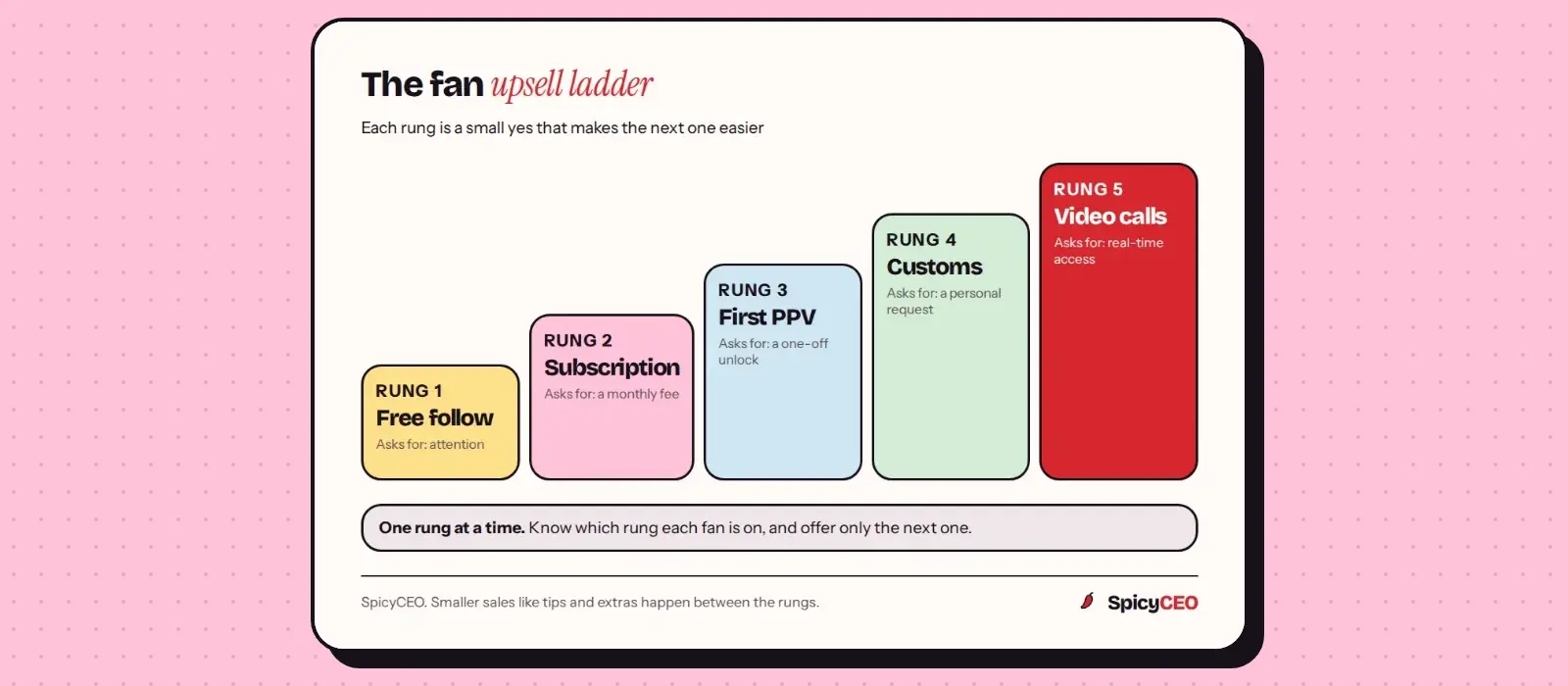
- The money comes from how far each fan travels with you: free follow → subscription → first pay-per-view → customs → video calls.
- The subscription is the front door, not the house. A brand-new subscriber is the most curious they will ever be, so that’s the moment to keep going.
- Don’t pitch the same offer to everyone. Read which rung a fan is on, write it in your fan notes, and offer only the next step.
- Move people up one rung at a time with a warm “bridge” message, never a hard sell.
- Protect your energy: give your time to the fans who climbed, use templates you personalise, and block your inbox hours.
Here’s something nobody tells you when you start: the biggest follower count in the room is rarely the biggest paycheck. The creator quietly out-earning everyone usually just worked out one thing early. Your inbox isn’t customer service. It’s your sales floor.
You can have a thousand subscribers and earn less than someone with two hundred. That’s not bad luck, and it’s not about looks. Money on a fan site doesn’t come from how many people subscribe. It comes from how far each of them travels with you after they do. That path has a name: the upsell ladder, sometimes called a sales ladder. This guide walks through the OnlyFans upsell ladder rung by rung (it works the same on any fan site), shows you how to spot which rung a fan is standing on, and how to offer the next step without sounding desperate.
1. Why follower count doesn’t equal income
Most creators measure the wrong number. Subscribers are easy to see, so they become the scoreboard. But a subscriber who pays the monthly fee and never buys anything else is worth exactly that fee. A subscriber who unlocks a few messages a month, orders a custom every so often and books the occasional call might be worth twenty times more.
Here’s an illustrative example with made-up but realistic numbers. Two creators, same month:
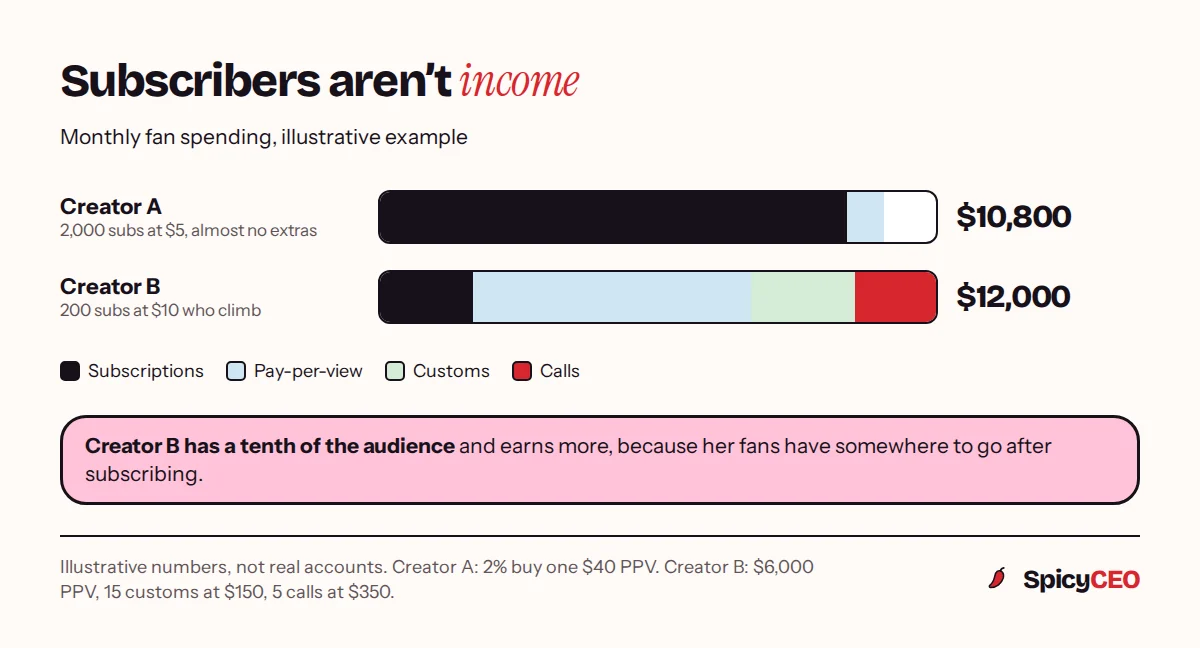
Creator A has ten times the audience. Creator B has a ladder. Same work week, very different business. And Creator B has a lot fewer people to keep happy, which matters more than it sounds when you’re the one answering every message.
2. What an upsell ladder is
An upsell ladder is the sequence of offers a fan moves through, starting at free and climbing to your most personal, most expensive tier. Each rung is a small yes, and every small yes makes the next one easier.
Someone who has never paid you is a stranger. Someone who just bought a $5 clip is a customer. Those are two completely different conversations, and the second one is much warmer.
The mistake almost everyone makes is building one rung and then a cliff. There’s a subscription, and then… nothing. A fan subscribes and the creator waits. Maybe a mass message goes out with a locked video and a prayer. If there’s no clear next step for that person, the relationship stalls instead of starting.
This isn’t tricking anyone. It’s the opposite. It’s noticing where someone actually is and offering them the thing that fits. The fans who climb your ladder are the ones who value you most and feel most seen. That’s good service, not a con.
3. The five rungs of the OnlyFans upsell ladder
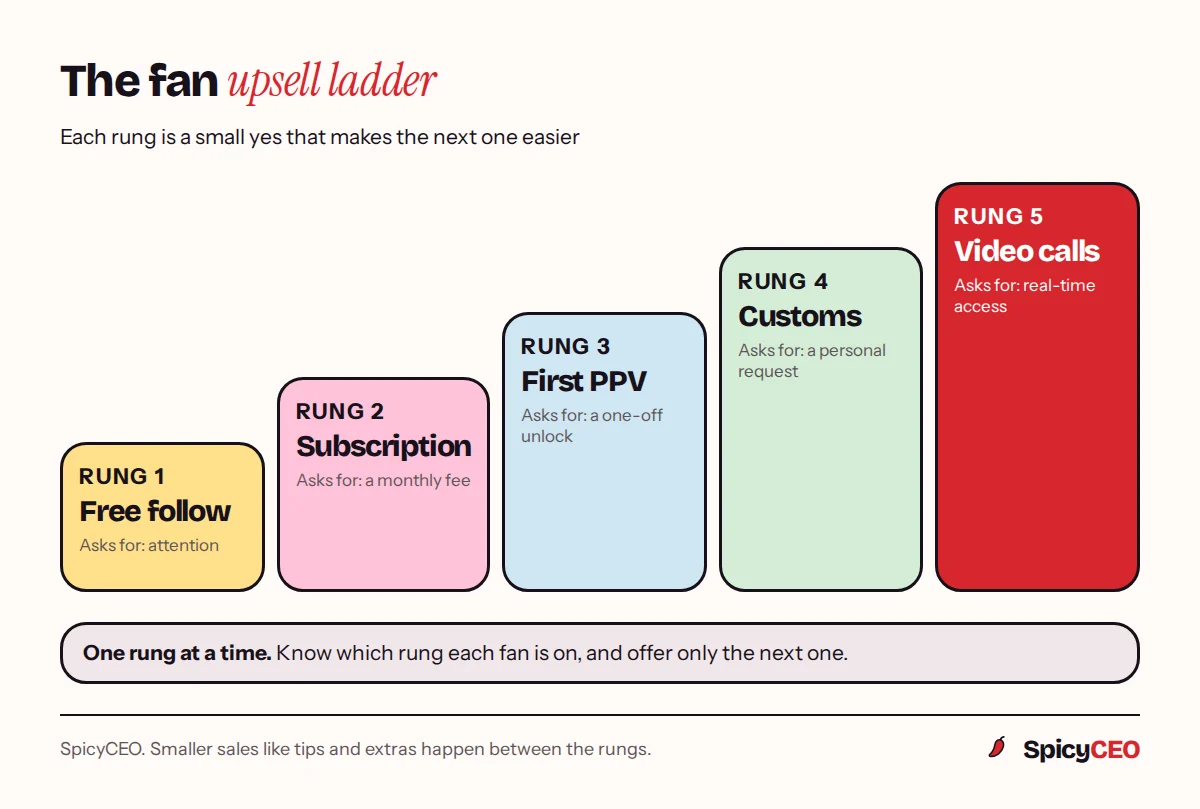
Rung 1: the free follow. Your socials, your free page, wherever a stranger first finds you. It costs them nothing but attention, and attention is an audition. The only job of this rung is to earn enough trust that someone is willing to get their card out. Don’t try to sell everything here. Just prove you’re worth a yes.
Rung 2: the subscription. The first paid yes, and a real psychological line to cross. Celebrate it, then reframe it: the subscription is the cover charge, not the night out. Most creators treat it as the finish line when it’s really the start of the relationship. A brand-new subscriber is the warmest, most curious and most open they will ever be. Keep going.
Rung 3: the first pay-per-view. The first time a fan spends money on top of the subscription. This rung tells you something you can’t learn any other way: this person will spend beyond the baseline. A subscriber who has bought one PPV is fundamentally different from one who never has. Fans often stay here a while, and that’s fine. As long as every unlock delivers, they learn to trust whatever’s behind the next one, and they get comfortable with slightly bigger amounts.
Rung 4: customs. The commitment gets bigger and much more personal. A custom says “make something just for me.” This is where a fan stops being a number in your subscriber count and becomes a person with a specific request you can fulfil. The price climbs, but so does the meaning. A really well-made first custom often spoils generic content for that fan: from then on, they want things made for them. (If you’re not sure what to charge, the custom content price calculator gives you a starting point that includes your editing time.)
Rung 5: video calls. Your top rung and your highest-touch offer. Calls should generally cost more than customs, because they cost you more. While you’re on a call, you’re not answering other DMs, not posting the promo that brings in new subscribers and not filming content that sells while you sleep. Real-time access to you is rare. Price it that way.
Between the big rungs there are plenty of smaller sales: tips, ratings, fan signs, little extras. They all count. But almost every serious dollar you’ll make lives somewhere on these five rungs, and your job is to know which fan is standing where.
Natalia’s take
In my first year, my whole business was rung two. People subscribed, I posted, and I waited for them to buy something. They mostly didn’t, because I never gave them a next step. It’s a business. Run it like one. A shop doesn’t just unlock the door and hope you find the till.
4. How to read which rung a fan is on
This is the part most people skip, and it’s the part that makes the ladder work: you don’t pitch the same offer to everyone. The fan who subscribed yesterday and the fan who has bought twelve customs shouldn’t get the same messages. If they do, you lose money in both directions. You overwhelm the new subscriber, and you make the loyal one feel like just another name on a list.
You don’t need a spreadsheet with a hundred columns. You need a rough answer to a few questions:
| Question | Lower rungs | Ready to climb |
|---|---|---|
| How long subscribed? | Days or weeks | Months, renewed more than once |
| Ever bought a PPV? | Not yet | Yes, and came back for more |
| How do they write? | One-word replies | Paragraphs, questions, details about what they like |
| Do they tip? | Only when asked, or never | Without being asked |
| What do they ask for? | Free extras | “Could you make…?” |
Write the answer in your fan notes, along with the next thing you want to offer them. Then every time you open that chat, the note works like a compass: you know where the conversation is meant to go.
Make the top rungs feel earned. Don’t offer customs to a fan you met an hour ago, and don’t fire off a full price menu to every new subscriber. When anyone can buy anything instantly, people value it less. Luxury brands understand this: some products you can’t just walk in and buy, you have to be a known customer first. You can borrow that logic. Tell new fans that customs are something you make for people you’ve got to know. It’s true, it protects you, and it makes the custom worth more when they get there. Getting to know a fan first is also one of your best defences against custom request scams.
5. Bridge messages: how to move a fan up one rung
Here’s the rule that keeps you from sounding thirsty and keeps fans from feeling sold to: move people up one rung at a time. You don’t meet a new subscriber and immediately pitch a $300 custom. That’s skipping rungs, and it feels targeted. (The exception is the fan who arrives asking for exactly that. Then you say yes, after your usual checks.)
The tool for climbing is a bridge message: a message that acknowledges what a fan just enjoyed and gently opens the door to the next thing. No begging, no pressure. Here’s how the climb typically looks:
- 01Subscription → first PPV. Chat first and learn what they like. Write it down. Make their first locked message match exactly that, so the first unlock feels made for them.
- 02One PPV → regular buyer. Once they’ve unlocked something, invite them into a longer one-to-one chat session where a few paid messages are part of the experience. If they enjoy it, they’ll come back for another.
- 03Regular buyer → custom. After a few good sessions, plant the idea: “You know what would be even better than talking about this? Me actually making it for you. A whole video, just for you.” They might say yes, change the idea, or think about it. Either way, the seed is planted.
- 04Custom → video call. After several customs: “We’ve made so many fun things together. Have you ever thought about doing this on a call instead?” Some say yes straight away. Some take months. Both are fine.
These are examples to rewrite in your own voice, not scripts to paste. And the tone matters as much as the timing. Every bridge should sound like you on your best day, talking to one person: warm, playful, never desperate. The second a fan smells pressure, the spell breaks. You’re not asking for money. You’re offering something they already showed you they want.
6. How to run your inbox without burning out
If this sounds like a second full-time job, you’re right to worry. Burnout is a bigger threat than the work itself. A little structure keeps it manageable:
Give your best attention to the fans who climbed. Everyone gets warmth, but your top-rung fans get more of you. That’s not being cold. It’s the only way this stays sustainable when you’re the one doing the chatting.
Use templates, but personalise them. Keep your most-used lines as keyboard text shortcuts, and longer templates in your notes app. Write them yourself (or draft them with an AI tool and rewrite them so they sound like you), then tweak each one to the conversation in seconds. Not copy-and-paste: a head start. That’s the difference between scaling and drowning.
Block inbox time instead of living in it. Your inbox will take every hour you give it. Give it set hours, then close it. Messaging becomes something you run, not something that runs you. If you don’t have an assistant, this one matters most.
And when fans drift off the ladder for a while, that’s normal too. Here’s a five-message system for winning quiet fans back without chasing.
7. The real takeaway
The money was never in having more fans. It was always in walking the fans you already have up the ladder, one rung at a time, like people rather than a funnel. Stop counting subscribers and start counting rungs. The creator who wins isn’t the one with the most followers. It’s the one who knows where every fan is standing, and what to offer them next.
Here’s your homework this week:
Quick questions
What is an upsell ladder on OnlyFans?
It’s the sequence of offers a fan moves through: free follow, subscription, first pay-per-view, custom content and finally video calls. Each step is a small yes that makes the next one easier, so income grows from how far fans travel with you, not just how many subscribe.
How soon should I offer a custom to a new subscriber?
Usually not straight away. Chat first, learn what they like and let them buy a pay-per-view or two. Offering customs only to fans you’ve got to know makes them feel more special, and it protects you from time-wasters and scams.
How do I upsell without sounding pushy?
Offer one rung at a time, and make it about what the fan already enjoyed: “You liked that, so you might love this.” Keep it warm and playful, accept a no gracefully, and never send the same pitch to everyone.
Should video calls cost more than customs?
Generally yes. A call takes you away from everything else in real time: other chats, promo and filming. A custom can be planned and batched around your schedule. Price the call for the time it really costs you.
Do I need a spreadsheet to track my fans?
No. A short note on each fan in your platform’s notes feature is enough: which rung they’re on, what they like and the next thing to offer them.
About this article. The two-creator example uses illustrative numbers, not real accounts. What works will depend on your niche, your prices and your fans. Always follow your platform’s rules on messaging, paid content and calls, and never make promises to fans that aren’t true. Spotted a mistake? Email [email protected].