The short version
- A brand-new subscriber asking for a custom straight away is a yellow flag. Slow down.
- “Write my name on your body” is one of the most common scam requests creators report. Treat it with suspicion.
- Scammers rush. A one-week deadline makes many of them disappear.
- Take a deposit before you discuss details, and at least half the price before you film.
- Watermark everything, somewhere that’s hard to crop out.
- Some refunds and chargebacks are inevitable. Your rules make them rare.
In 2020 I learned the hard way that once your content leaves your page, you lose control of where it goes. Custom requests are one of the easiest ways for that to happen, because a scammer gets exactly what he asked for, made just for him.
So when a creator shared how she spotted a scam custom request before it cost her anything, and dozens of creators added their own rules, I wanted to put the whole playbook in one place. This is how OnlyFans custom request scams usually work, the red flags, and the boring business rules that stop most of them.
What this is based on. Creators sharing their own experiences in 2026. Scams change, and nobody outside the scammers knows exactly what happens to stolen content. Treat this as a checklist of warning signs, not a guarantee.
1. The request that should make you pause
Here’s how hers went. A man subscribed and, almost immediately, messaged asking for a custom. Part of the request: write his name on her body.
Some new subscribers who ask for a custom on day one are completely genuine. But in her experience, and plenty of others’, it’s a pattern: a scammer wants as much content as possible in as little time as possible, before the payment gets reversed.
Several creators had received what sounded like the exact same message, word for word, the same week. One brand-new creator said her very first subscriber used almost the same wording.
2. Why “write my name on your body” is such a popular request
Creators describe two main ways this content gets misused:
- Fake “proof”. A photo of you with his name or username written on your body looks like proof that you’re a real person he knows. Creators report it being used to verify fake accounts or to convince buyers elsewhere that the content is his to sell.
- Reselling. The content gets sold on as if it were exclusive, using your face or body as the selling point.
Not every name request is a scam. One buyer said it’s genuinely his thing, and that it’s also how he knows a video wasn’t pre-made. Some creators sell these regularly and say they’ve never had a problem.
So it’s a boundary call, and it’s yours. If you do offer it: never for a brand-new subscriber, always with a big watermark, and only once payment is in.
3. Red flags and green flags
One flag on its own doesn’t prove anything. Two or three together is your cue to slow everything down.
4. How the money side of the scam works
The worst part of a scam custom isn’t only the stolen content. It’s doing the work and then losing the money.
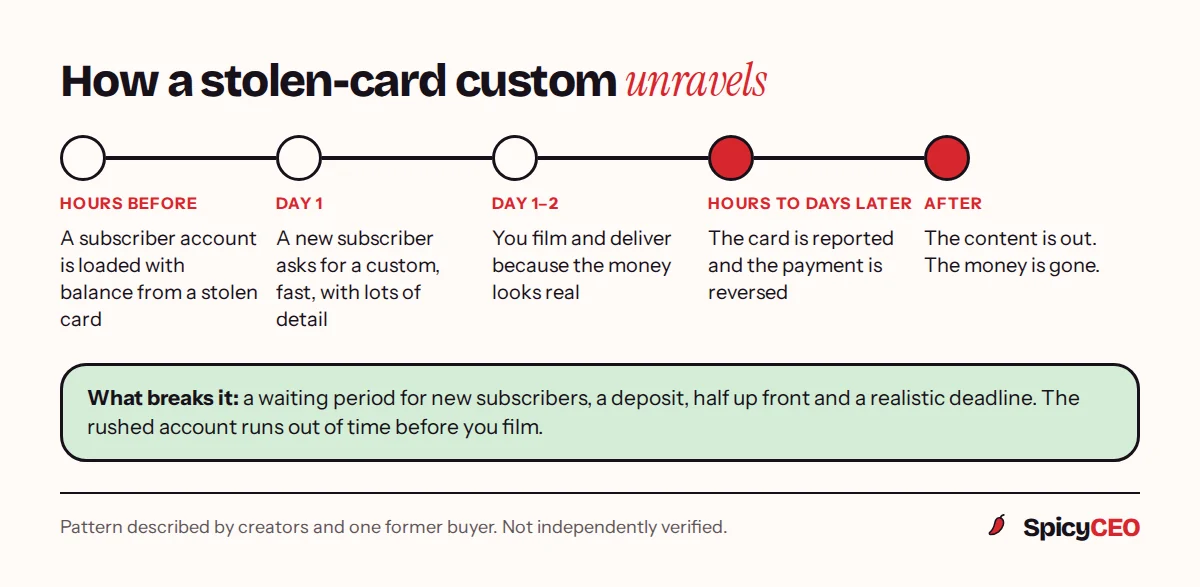
One man who said he used to buy them described how some of these accounts operate: subscriber accounts loaded with balance from stolen cards are sold cheaply in private groups, and they only last a few hours or a day before the card is reported. When that happens, the payment is reversed. We can’t verify that claim, but it would explain why so many scam requests are rushed: the account has to use the balance before it disappears.
Many creators also feel they get little support from the platform when a chargeback lands. So the safest assumption is simple: prevention is your job, because recovery mostly isn’t possible.
5. The rules that stop most custom scams
None of this is complicated. It’s just running customs like the business they are.
- 01Set a waiting period. One creator doesn’t take customs from anyone in their first three days as a subscriber. She explains it nicely, and the serious ones stick around.
- 02Take a deposit before discussing details. Plenty of people enjoy describing the custom and never order. A deposit separates buyers from talkers.
- 03Get at least half before you film. Half up front, half on delivery is the most common setup. If the second half never comes, you’ve still been paid for your time.
- 04Give a realistic deadline. A week, or one to two weeks. When she added a one-week timeframe, the scammer simply stopped replying.
- 05Watermark everything. Put it across the stomach or middle of the frame, where it can’t be cropped out without ruining the shot. Free tools like Canva can do this.
- 06Turn on content protection. Creators mention a DRM or screen-capture protection setting for videos. Check your platform’s settings and switch it on.
- 07Write your rules down. A custom menu saying what you will and won’t do, with your prices and payment terms, means fewer arguments later.
| Setup | How it works | What it protects you from |
|---|---|---|
| Deposit first | Small payment before you talk details | Time-wasters who just want to chat |
| Half up front, half on delivery | Film after the first half, send after the second | Doing all the work for nothing |
| Full payment first | Film only once everything is paid | Non-payment (not chargebacks) |
| Blurred preview | Send a blurred version, the full one after final payment | Buyers who disappear before the second half |
One creator asked a fair question: what if someone pays a deposit, then asks for something you won’t do? The answer from another: adjust the request to something you’re happy to make. A clear menu means it rarely comes up.
Natalia’s take
Nobody legitimate minds paperwork. A deposit, a deadline, a watermark and a written menu are what any small business has. If a fan gets angry about basic terms, he just told you everything you needed to know. Fans are customers. Treat them well, but they’re customers.
6. If it already happened
First, don’t beat yourself up. Several creators admitted they made exactly these customs when they were starting out, because nobody had told them. Refund requests and chargebacks happen to everyone eventually. As the original poster put it, people who didn’t want to pay for your content were never going to.
Then:
- Save everything. Screenshots of the messages, the payment and the refund.
- Report and block the account on the platform.
- Use creator-run blocklists, where creators flag accounts that charge back, if you use one. Check their rules first. Posting someone’s profile publicly in a community can get your post removed.
- Watch for your content. If it shows up somewhere else, send a copyright takedown (DMCA) to the site hosting it. I did a lot of these after 2020. It’s tedious, and it works more often than you’d think.
- Tighten one rule. Add a waiting period, a deposit or a bigger watermark, whichever would have stopped this one.
7. Price customs like they’re worth protecting
The rules above work best when your customs are priced properly. One creator charges around $100 for a three-minute custom, and when another asked whether she should charge more, the answer was simply: you can charge whatever you want. Cheap customs attract exactly the buyers who don’t respect your terms. If you’re still undercharging, read how to raise your prices without losing your fans.
Quick questions
Is a request to write a name on my body always a scam?
No. Some buyers genuinely enjoy it. But it’s one of the requests creators most often link to scams, especially from brand-new subscribers. If you offer it, wait until they’ve been around a while, take payment first and watermark it heavily.
Should I take full payment before filming a custom?
Many creators do. Others take half before filming and half on delivery. What almost nobody recommends is filming with nothing paid. The free custom content price calculator works out your price and deposit.
Is it rude to refuse customs from new subscribers?
No. A short, friendly explanation (“I take customs from subscribers after their first few days”) is a normal business rule. Serious buyers wait.
What can I do after a chargeback?
Report and block the account, keep your screenshots, and watch for the content appearing elsewhere so you can file takedowns. Then add one rule that would have prevented it.
Do watermarks actually help?
Yes. A watermark across the middle of the frame is hard to remove without ruining the content, and it tells anyone who finds a stolen copy where it came from. Some creators say fans have reported stolen content to them because of their watermark.
About this article. Based on creators’ own experiences shared in 2026, including some claims we couldn’t verify (such as how scam accounts are funded). This is general guidance, not legal advice. Spotted a mistake? Email [email protected].