The short version
- Almost every creator gets leaked eventually. It’s a cost of doing business, not a sign you did something wrong.
- Filing takedowns yourself is slow, and many forms ask for your legal name and address. A service files them for you as your agent.
- Getting leaks out of Google is the realistic win. Some sites never remove anything.
- Rulta, BranditScan and ClipSentry were the names creators kept mentioning. They differ in price and in how they find your content.
- The bigger danger is often impersonation: fake accounts and Telegram channels selling “you”. Ask what each service does about that.
- Watermarks, a second paywall for your best content and a separate identity make every leak hurt less.
In 2020 I went through a leak and a doxxing scare, and for a while I spent my evenings filing takedown notices one by one. I don’t miss it. So when a creator posted that she’d found almost a month of her feed on three tube sites and was done fixing it alone, I recognised the feeling exactly.
She asked a simple question: which DMCA takedown service actually works, and isn’t a fortune for a creator who isn’t in the top 0.1%? Creators answered with their own experiences, good and bad. This is what they said, checked against each service’s current prices, plus what I learned the hard way.
What this is based on. Creators’ own experiences, shared in 2026, and each service’s public pricing page as of October 2026. Prices change. SpicyCEO has no affiliate deal with any of these companies and doesn’t earn anything if you sign up.
1. First, breathe: what a leak actually means
Finding your content on a site you’ve never heard of feels like a punch. One creator said googling her own name sent her into a spiral for days. That’s normal.
But here’s the business view. Leaks happen to small creators and huge ones. Some of your wall content will end up somewhere, whatever you do. What you control is how easy it is to find, how much of your best content is out there, and whether anyone can pretend to be you.
That last one matters most. As one creator pointed out, the leaked videos are rarely what costs you the most. It’s the scammers impersonating you: fake accounts, Telegram channels selling your content, people chatting to “your” fans and asking for money.
2. Why doing takedowns yourself burns you out
You can file takedown notices yourself. Under US copyright law (the DMCA), a valid notice needs a description of your work, where the copy is, a signed statement and contact details: an address, phone number and email. That’s exactly what stops many creators. One found the form wanted her full legal name and home address, and she wasn’t going to hand that to a site already stealing from her.
Most creators who tried it gave up for the same reasons:
- It never ends. One creator called it whack-a-mole. Another said trying to find out who was stealing what made her paranoid.
- It takes hours you could spend making content or promoting.
- Many sites ignore you, especially ones hosted outside the US.
There are some things you can do alone. You can ask Google to remove infringing pages from search through its copyright removal request, and one creator says you can file it with your stage name and a third-party or PO box address. Whether a site accepts that varies. A takedown service avoids the question: the notice goes out in their name, as your authorised agent.
3. What a takedown service actually does
Most services do the same four things, with very different quality:
- Find copies of your content, by searching your usernames, by facial recognition, or by fingerprinting your videos.
- Send takedown notices to the sites and their hosting companies.
- Delist the pages from Google and other search engines, so people searching your name don’t find them.
- Report fake accounts on social platforms, on some plans.
Be realistic about what “removed” means. Delisting from Google is the fast, reliable part. Getting the file itself deleted depends on whether the site cooperates.
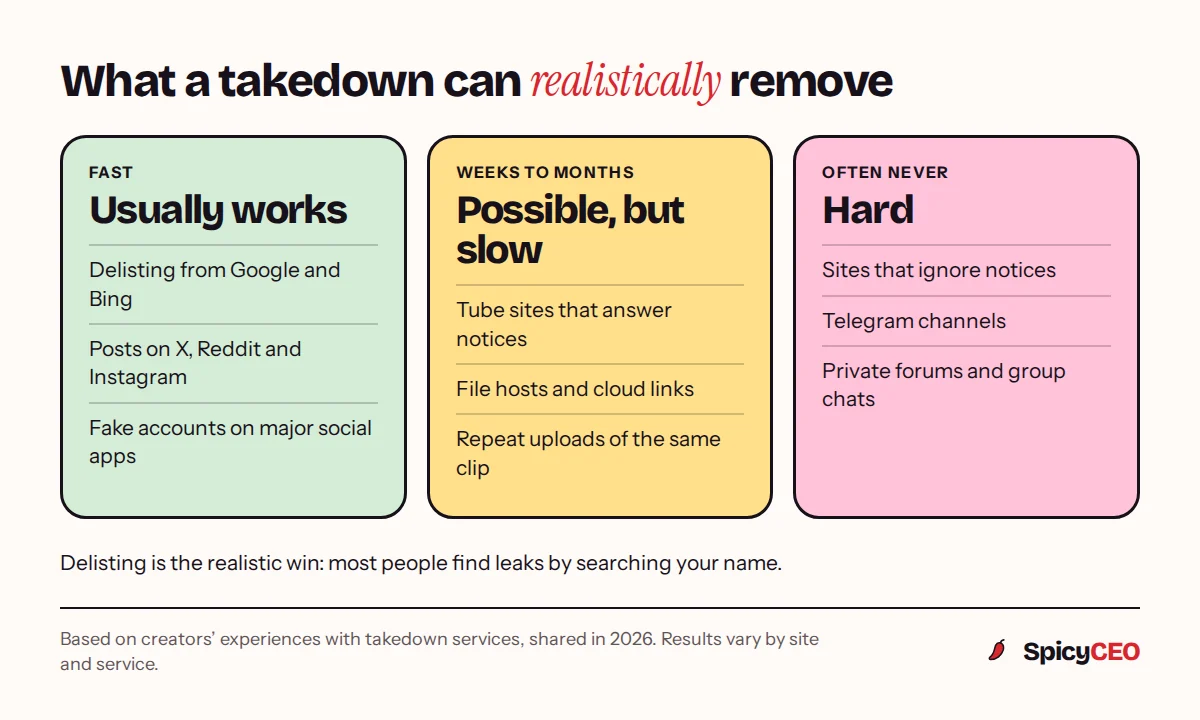
One creator, a happy long-term user, put it honestly: even when not everything can be removed, her service finds it fast and delists it. For most of us, that’s the win. People find leaks by searching your name. If the search shows nothing, most of them never get there.
4. The three DMCA takedown services creators mentioned
These came up again and again. I haven’t tested them myself, so this is what creators reported, next to what each company publishes. Other services exist too; the same questions apply to all of them.
| Service | How it finds leaks | Price from | What creators liked | What creators criticised |
|---|---|---|---|---|
| Rulta | Searches by your usernames; plans priced by how many usernames you protect | $139/month + VAT (Premier $184, Legend $324) | Daily email reports, you can send links to a named agent, real people to talk to, global takedowns, finds fake accounts | Expensive for smaller creators; one felt much of it is automated for the price |
| BranditScan | AI and facial recognition, hourly scans | $69/month, first month half price (White Glove $149) | Low effort, a dashboard of what was found and removed, fast Google delisting, used for years by several creators | False matches (flagging people who weren’t her), slow removals on X for one creator, missed clips without her username |
| ClipSentry (by Takedown Piracy) | Digital fingerprints of your videos, which catch cropped or edited copies | $150/month | Found videos another service missed; got X videos removed in under 48 hours | The price; it’s built around videos and clips |
A few details worth knowing:
- Rulta’s plans differ in more than usernames. Fake-account removal starts on the middle plan, and Telegram leak removal is only on the top one, according to its pricing page. One creator said Rulta was working on removing a Telegram channel impersonating her.
- BranditScan was the one smaller creators recommended most, mostly for the price. One noticed more paid subscribers after a lot of her leaked content came down. Another, less happy, lost a four-year-old Reddit account within a week of signing up; she couldn’t prove the two were linked, and neither can I.
- Reviews aren’t neutral. One creator pointed out that BranditScan runs a generous referral program, so many glowing reviews you’ll find online come from people earning a commission. That’s true of plenty of creator tools. Weigh reviews from people with nothing to sell.
Natalia’s take
Pay for the thing that hurts most. If your problem is your name all over Google, cheap delisting does most of the job. If someone is selling “you” on Telegram, you need a service that handles impersonation, and that costs more. Don’t buy the top plan for a problem you don’t have. And whoever you hire, read the contract first: here are the agency contract clauses to check.
5. How to choose: questions to ask before you pay
- 01Check your privacy. Ask in writing whether they file notices without your legal name and address. One creator confirmed this with her service before signing up.
- 02Ask how they find content. Usernames miss leaks posted without your name. Facial recognition can flag the wrong person. Fingerprinting needs your videos.
- 03Ask about impersonation. Do they remove fake accounts and Telegram channels, and on which plan?
- 04Ask for proof. A dashboard or daily report showing what was found, sent and actually removed, not just “notices sent”.
- 05Whitelist your own accounts. Good services let you list your official profiles so they’re never reported by mistake.
- 06Start monthly. Try a month or use the first-month offer, compare what you see in search before and after, then decide.
- 07Keep a little DIY. Several creators still search their own name now and then and send new links to their service.
6. Make the next leak hurt less
A takedown service cleans up. These habits mean there’s less to clean:
- Watermark everything with your username or link, across the middle where it can’t be cropped out. One creator said leaks carrying her link even brought her a few subscribers, because people could find the real page. More on watermarks in the custom request scams guide.
- Put your best content behind a second paywall. One creator guessed that a leak this big meant the page had no pay-per-view at all. Everything on your wall gets leaked eventually; pay-per-view content still can, but far fewer people have it.
- Consider changing or adjusting your stage name if your current one is flooded with leaks. It’s a big step, but it cuts the link between your name and the leaks.
- Check your social privacy settings. One creator recommends switching off Reddit’s option to show your profile in search engines.
- Keep your identities separate. A separate phone number, email and bank account from day one. After 2020 I separated everything, and it’s the reason a leak never again felt like a threat to my real life.
7. Is it worth the money?
Do the maths like any other business cost. If your subscription is $10, you keep $8 after the platform’s 20%. So a $69 plan needs about nine extra subscribers a month to pay for itself, and a $150 plan about nineteen. That assumes leaks are costing you sales, which nobody can measure exactly.
Count the other things too: the hours you get back, and the stress. Several creators said the main benefit was peace of mind. One called it the best thing she’d invested in for her business. If you’re earning very little, a cheap plan and some DIY delisting is a reasonable start. If someone is impersonating you, act now, because that hurts your fans as well as you.
Quick questions
What is a DMCA takedown service?
A company that searches the web for copies of your content and sends legal takedown notices to the sites, hosts and search engines on your behalf, usually for a monthly fee.
Do I have to give my legal name to file a DMCA takedown?
A notice needs the contact details of the person filing it. If you file yourself, that’s you. A takedown service files as your authorised agent, so their details go on the notice. Confirm this with any service before signing up.
Can a takedown service remove everything?
No. Delisting from Google and removals from major social platforms usually work. Sites that ignore notices, often hosted abroad, may keep the files up. Delisting still stops most people finding them.
Which is better, Rulta or BranditScan?
It depends on your budget and your problem. In this discussion, BranditScan was popular with smaller creators for its price, while Rulta users praised its reports, agents and impersonation work. Creators who wanted to catch edited copies of their videos preferred fingerprinting, as ClipSentry uses.
How do I stop my content from leaking?
You can’t stop it completely. Watermark everything (our free watermark tool does it in your browser), keep your best content behind pay-per-view, and keep your creator identity separate from your real one so a leak stays a business problem.
Sources
- Rulta: How much does Rulta cost? (plans and features)
- BranditScan: Pricing
- ClipSentry by Takedown Piracy: plans and how fingerprinting works
- 17 U.S.C. § 512: what a DMCA notice must contain (Cornell Law School)
- Google: Report content for legal reasons, including copyright
Based on creators’ experiences shared in 2026 and each company’s published prices in October 2026. We haven’t tested these services ourselves, and results vary by creator and by site. No affiliate links. This is general information, not legal advice. Spotted a mistake? Email [email protected].