The short version
- The biggest OnlyFans niches are the biggest because everyone already knows about them. Big demand usually means big competition.
- Read three things before you choose: size (how many fans want it), trend (is interest growing or fading) and place (where those fans live).
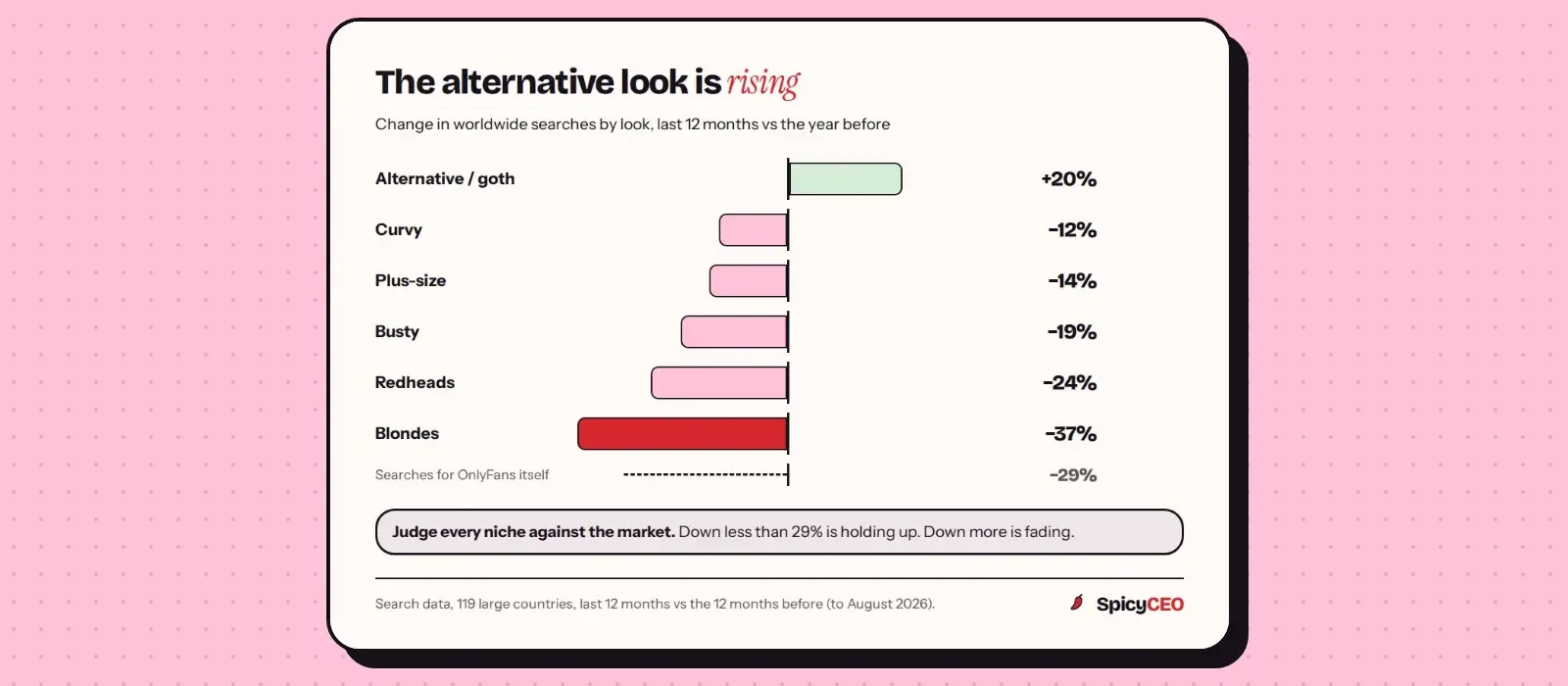
- Searches for OnlyFans itself fell about 29% in a year as people go straight to the app, so almost every niche looks “down”. Judge each one against that.
- The alternative look (think goth, tattoos, dark style) is the only one still growing worldwide (+20%). Searches for blondes fell 37%.
- The #1 niche changes by country: dominant women in Germany, feet in Spain, anime cosplay in the Philippines.
- In some countries, three out of four fans looking for a nationality want a creator from home. Being local can be your niche.
Every new creator asks the same question: which niche makes the most money? It’s the wrong question. The niche with the most fans also has the most creators fighting over them. The better question is where demand is strong and you can still be one of the few names people remember.
Most advice about choosing an OnlyFans niche is a list of popular categories with no numbers behind it. So I looked at real search data: what fans in 119 countries searched for between January 2024 and August 2026, split into niches, looks and backgrounds, with the 12-month change for each. Search data has limits (it shows curiosity, not money, and it can’t count how many creators already serve a niche), but it tells you a lot about where fans’ attention is going. Here’s how to read it.
1. Big isn’t the same as good
Worldwide, a handful of niches take a big share of the searches:
Look at that list like a shop owner, not a fan. MILF is the single biggest niche on Earth, so every creator who fits it already uses the word. If you’re new, you’d be opening a coffee shop on a street that already has forty. You can win there, but you need a reason someone picks you over the other thirty-nine.
Two things to notice. First, “Famous faces” isn’t a niche you can choose: it’s fans looking up famous names, so read past it. Second, the smaller niches lower down are far from tiny. A 4% share of a worldwide market is still a lot of fans. It’s just less crowded.
Natalia’s take
Before I ever posted a photo, I spent five years in agency marketing, and every product launch started the same way: look at the shelf before you put something on it. Who’s already there, what do they charge, what’s missing? Choosing a niche is exactly that. It’s a business. Run it like one.
2. Read the OnlyFans niche trend, not just the size
Size tells you about today. The trend tells you about next year. But there’s a catch: searches for OnlyFans itself dropped around 29% in twelve months, because people now open the app directly instead of googling it. Visits and spending kept growing. So almost every niche shows a fall, and a fall alone doesn’t mean fans are leaving.
The trick is to compare each one to that background drop. A niche down 14% is holding up well. One down 37% is genuinely fading.
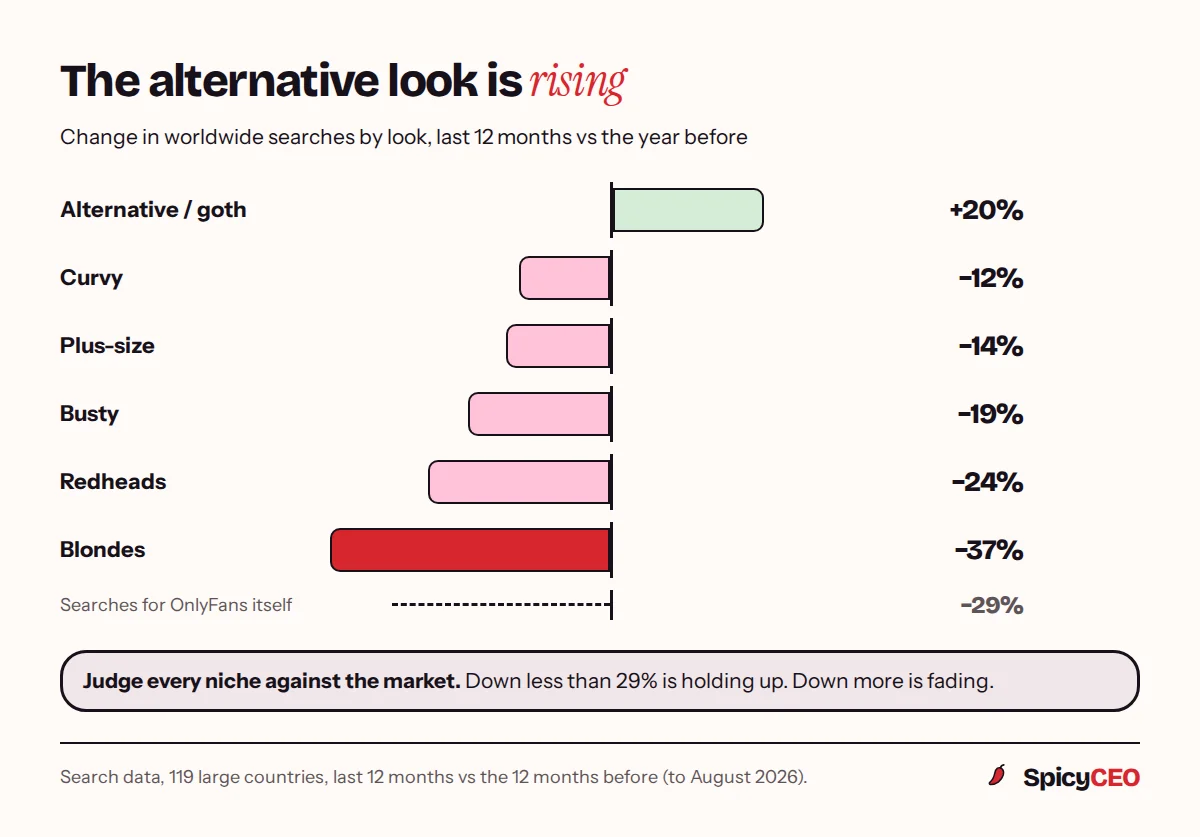
The alternative look is the standout. Dark, gothic, tattooed, a bit different: it’s the only look still growing worldwide, up 20%, and it’s now the most-searched look in 26 of 119 large countries, including Germany, France, Spain, Poland, the Netherlands and Greece. It grew 23% in Spain, 20% in Germany and 39% in Italy in a year.
Blondes are the warning. Searches fell 37% worldwide and 52% in the US. That doesn’t mean blonde creators can’t earn. It means “blonde” on its own is no longer a reason for anyone to find you.
Over-40 creators are steady. They’re one of the three biggest niches worldwide and fell less than most (−14%). In the UK it actually grew 8%. If you’re over 40 and worried you’re “too old” for this, the data says the opposite.
A rising trend is an invitation, not a guarantee. When something grows, more creators notice and pile in. The sweet spot is a niche that’s growing and that you’d genuinely enjoy making content for in two years, when it’s busier.
3. Read the map: the #1 niche changes by country
The same platform, completely different tastes. Ignore celebrity searches, and the most-searched niche and look in some big markets are:
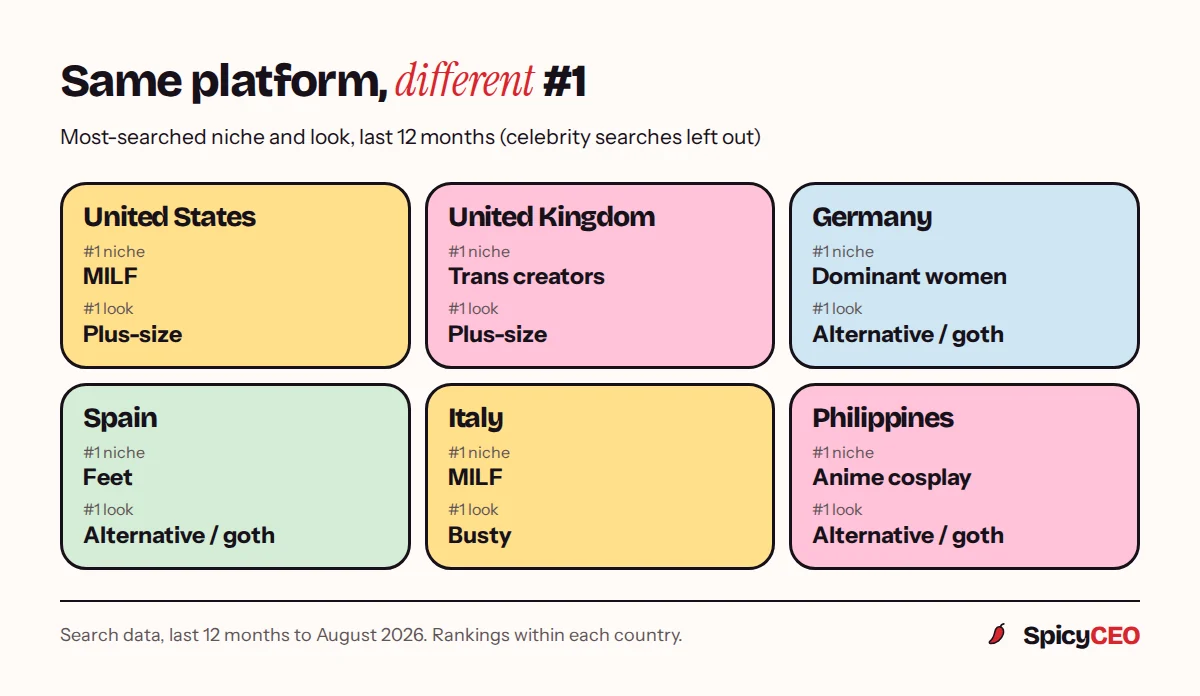
This matters for one reason: you choose where to promote. Your niche doesn’t only have to fit you. It has to fit the people who see your posts. An alternative-style creator promoting mostly to American fans is fishing in a pond where that look is #2. The same creator posting to German, Spanish or Polish audiences is fishing where it’s #1.
Here in Spain, where I live now, the most-searched niche is feet. In Germany it’s dominant women. In English-speaking countries, plus-size is the top look across the US, UK, Canada and Australia. None of these are universal truths about “what sells”. They’re local markets.
Practical use: check where your current fans come from in your platform’s statistics, then compare your content with what fans in those countries actually search for. Your social posting times, captions and even language can follow.
4. The home advantage: when “local” is the niche
One of the most underrated niches isn’t a category at all. It’s where you’re from.
When fans search for creators of a specific nationality, how often do they search for their own country?
In Greece, Finland and Sweden, about three out of four of those searches are for creators from home. That’s a market where global stars barely compete, because what fans want is someone who speaks their language, gets their jokes and lives in their time zone. Smaller countries, smaller pond, far fewer creators fishing in it.
The trade-off is privacy, and it’s a big one. Being “the Greek creator” makes you easier to recognise at home. If you lean into a local niche, do it with a stage name, a separate phone and email, no location data in your photos (my free location remover strips it out), and think hard about blocking your own region if neighbours finding you would wreck your life. Most fan platforms let you block countries in settings.
5. Stack your niche until it’s yours
A crowded niche gets much less crowded when you combine it with something else. Think in layers:
| Layer | Examples | On its own |
|---|---|---|
| Niche | Over 40, anime cosplay, domination | Busy |
| Look | Alternative, fitness, redheads | Busy |
| Background or language | Spanish-speaking, Nordic, local to your country | Often quiet |
| Personality and hobby | Gamer, gym-obsessed, bookworm, dry humour | Yours alone |
“Over 40” is crowded. “Over 40 + alternative” is a smaller room. “Over 40 + alternative + Spanish-speaking + plays horror games on stream” is a room with you in it. Each layer cuts the competition and gives you new places to promote: gaming communities, fitness spaces, language-specific forums, hobby subreddits. (The Reddit promo guide covers how to use those without getting banned.)
Two layers that fit together naturally beat four that feel forced. Fans can tell when a “gamer girl” has never held a controller.
6. Check how crowded it really is
Search data shows you demand. It can’t show you supply, and there’s no reliable public count of how many creators serve each niche. You check that part yourself, and it takes about an hour:
- 01Search like a fan. Use creator search sites and the platform’s own search for your niche words. Note how many results there are, and how many look active in the last month.
- 02Study the top 20. For the creators who show up first: what do they charge, how often do they post, what does their free content look like? Write down what they all do the same.
- 03Find the gap. The gap is whatever none of them do: a language, a time zone, a format (audio, long videos, cosplay themes), a personality. That’s your angle.
- 04Check the promo spaces. Look at the communities for your niche. Lots of fans and few creators posting? Good sign. Every second post is a creator? Crowded.
- 05Test before you commit. Post your niche content for four to six weeks alongside your usual posts and compare clicks and subscribers. Data beats gut feeling.
7. Pick a niche that sells beyond the subscription
One last filter, and it might be the most important. More and more creator income comes from pay-per-view, tips, messages and customs rather than the monthly subscription. So ask: does this niche give fans a reason to buy more?
Niches built around a story, a character or a specific request (cosplay themes, roleplay, a fetish with endless variations, a personality fans want to talk to) naturally lead to customs and long conversations. Niches built only on a look tend to stop at the subscription. Here’s how to walk fans up from subscriber to regular buyer once they’re in.
And be honest about the other side: can you make this content happily for years? A niche you hate will show in your content within three months, and fans can smell it. Demand gets fans to your page. Enjoying it is what keeps you making content they stay for.
Quick questions
What is the most popular OnlyFans niche?
Worldwide, MILF gets the most niche searches, followed closely by creators over 40. Popular also means crowded, though, so a new creator usually does better by combining a popular niche with something more specific.
Which OnlyFans niches are growing?
Most niches show falling search numbers because people now go straight to the app instead of searching. Compared with that background drop, the alternative look is the clear riser (+20% worldwide), and creators over 40 are holding up better than most.
How do I know if my OnlyFans niche is too crowded?
Search for it like a fan would, study the top 20 creators, and check the communities where you’d promote. If every second post is from a creator and they all look alike, it’s crowded unless you add a layer they don’t have.
Do I need a niche to start on OnlyFans?
No. Many creators find their niche by posting different things and noticing what gets the best response. But once you see a pattern, lean into it, because a clear niche makes you easier to describe, find and remember.
Does my country affect which niche I should choose?
It can. The most-searched niche and look change from country to country, and in some countries most fans looking for a nationality want creators from home. Check where your fans are in your statistics and match your promotion to them.
About this article. Demand figures are based on search data for 119 large countries from January 2024 to August 2026, with 12-month changes comparing the last year with the year before. Search interest shows curiosity, not spending, and can’t show how many creators serve each niche. Spotted a mistake? Email [email protected].