The short version
- An agency pitch sells growth. The contract decides who owns your account, content, logins and exit. Read the contract, not the pitch.
- “50%” isn’t one number. 50% of gross can leave you with less than half of what you’d keep alone. Ask what the percentage is taken from.
- Keep your email, passwords, two-factor login and payout account in your name, always.
- Watch for auto-renewals, exit fees and “tail” commissions that keep paying the agency after you leave.
- If someone else chats as you, the platform still holds you responsible. Get the rules in writing.
- Never sign on the day you’re asked. A short review by a lawyer costs far less than a bad contract.
In six years I never worked with an agency. I turned down three. Not because agencies are evil (some are genuinely good), but because each time, the problem was in the contract, not in the pitch. The pitch is about how big they’ll make you. The contract is about what happens to your money, your account and your content when things go wrong.
So this is the guide to reading an OnlyFans agency contract, or any management, chatting or marketing agreement, before you sign. I’m not a lawyer, and this isn’t legal advice for your situation. It’s the list of clauses that cost creators the most, based on what creator-focused lawyers warn about and what creators report, plus what a fair version looks like.
The golden rule. If an agency won’t give you the contract to take away and read, or pressures you to sign today, that’s your answer.
1. The commission: “50%” of what, exactly?
This is the clause everyone looks at, and most people still read it wrong. The percentage matters less than what it’s taken from.
- Gross usually means everything fans spend, before the platform takes its 20%.
- Net usually means what actually reaches your account after the platform’s cut.
- Some contracts go further and take their share before deducting ad spend, chatter wages or tools, which they then also charge you for.
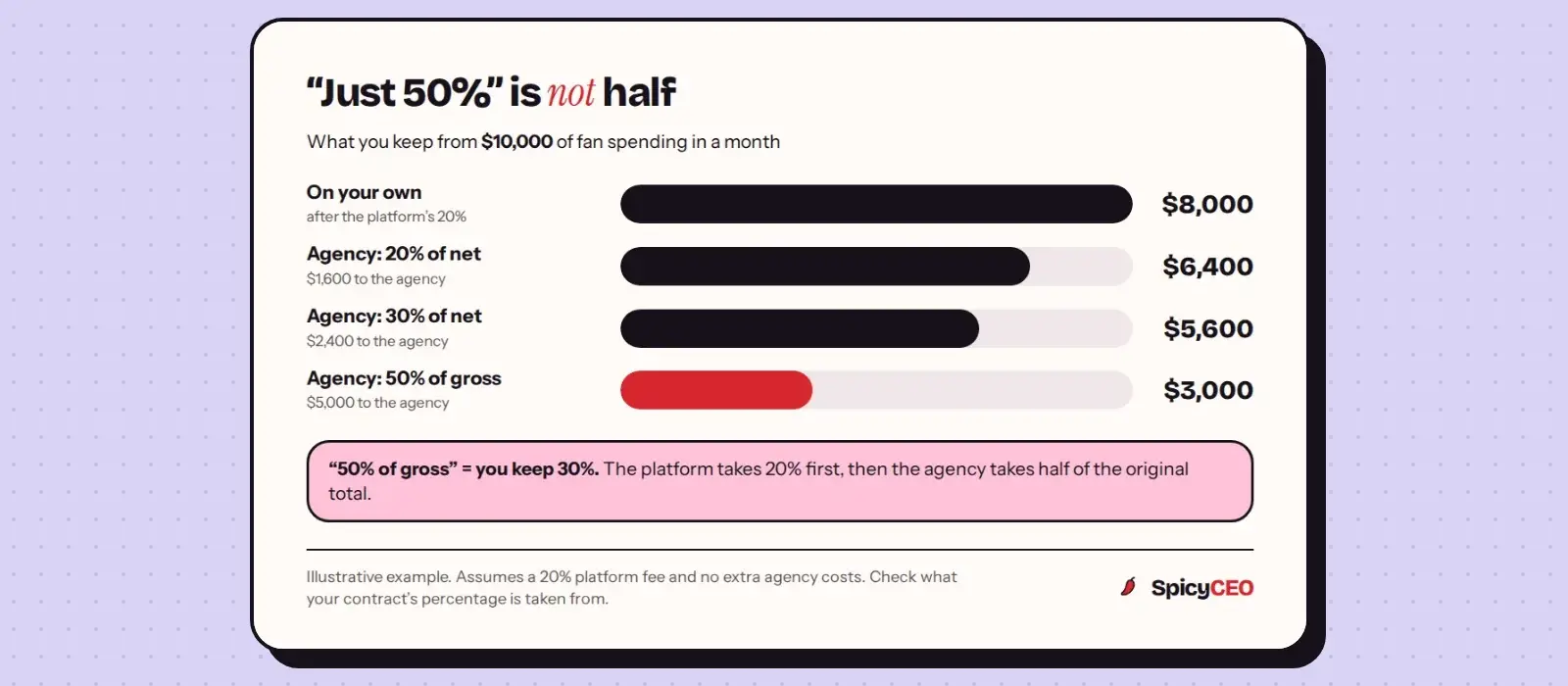
Here’s what that does to $10,000 of fan spending in a month:
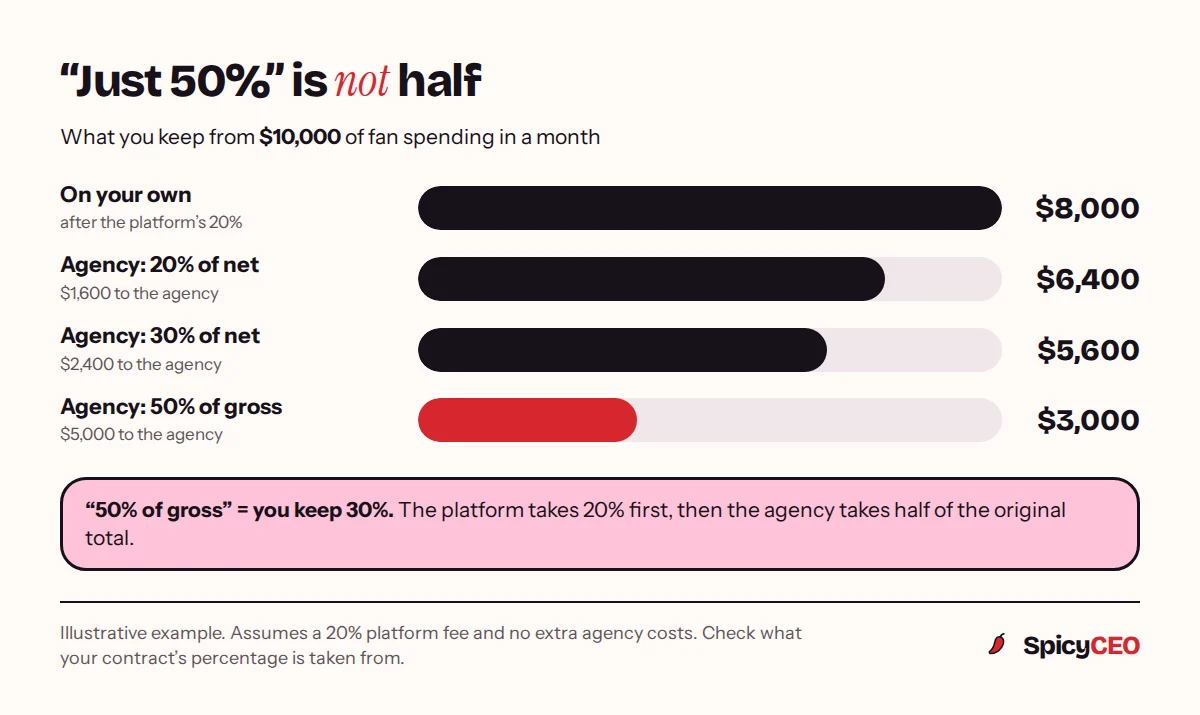
A 50% cut of gross isn’t half. It’s the platform’s 20% plus half of the original total, so you keep 30%. Creator-focused lawyers commonly suggest that a fair management commission sits closer to 15 to 20% of net for most services, rising only if the agency genuinely runs everything and brings real traffic.
Ask for: commission on net earnings, a clear list of what the commission includes, and no extra costs charged without your written approval. To see what any deal means for you, run it through the free agency commission calculator.
2. Account ownership and logins
The single most dangerous clause is the one that lets an agency control your account. If they own the email address, the password or the two-factor login, they own your business.
Red flags: the account is registered with the agency’s email; they “manage” your two-factor login; you don’t have your own working password; the contract says the account or username belongs to them.
Ask for: the account, email, phone number and two-factor method stay in your name. If they need access, they get a separate team login where the platform offers one, and you can change your password at any time.
3. Payouts: whose bank does the money land in?
Your earnings should always land in your payout account first. The agency then invoices you for its commission.
Red flag: your payouts go to the agency, which pays you “your share” later. If they’re late, wrong, or the agency disappears, you have no money and no records.
Ask for: payouts to your own account, monthly statements, and the right to see the platform’s earnings data yourself.
4. Who owns your content
Some contracts quietly give the agency ownership of, or a permanent licence to, everything you create while you’re signed, including content made before you joined.
Ask for: you own all your content. The agency gets a limited licence to use it only to promote your page, only while the contract runs, and it must delete its copies when the contract ends.
5. Term, auto-renewal and exit fees
Long terms aren’t automatically bad. Being trapped is.
Red flags: a term of more than a year, automatic renewal unless you object in a narrow window, and an exit fee or “buyout” to leave early. Creator-focused lawyers single out auto-renewals and expensive termination fees as some of the most common traps.
Ask for: a short first term (three to six months), renewal only if both sides agree, and the right to leave with 30 days’ notice and no fee.
6. The “tail”: paying them after you leave
A tail clause says the agency keeps earning commission after the contract ends, often on any fan who subscribed while you were with them, sometimes for a year or more, sometimes forever.
Ask for: no tail, or a short one (a month or two) on money from specific campaigns they can prove they ran.
7. Exclusivity and non-compete
Some contracts stop you from working with anyone else, opening pages on other platforms or even doing your own promotion.
Ask for: exclusivity only for the specific service they provide (for example, chatting), never for your whole career, and nothing that limits what you do after the contract ends. You should always be free to earn on other platforms.
8. Chatters and speaking as you
Many agencies provide chatters who message fans as you. That’s a big deal: fans think they’re talking to you, and the platform still treats you as responsible for everything sent from your account.
Ask for: written rules on what chatters can and can’t say or sell, no promises you wouldn’t make yourself, nothing that breaks your platform’s current terms, and access to read all conversations. If anything goes wrong, the contract should say who pays for it. Check your platform’s own rules on who may use your account before you agree to anyone else messaging from it.
9. Your personal data
To run your page, an agency may see your legal name, ID, address and bank details. That’s exactly the information that becomes dangerous if it leaks.
Ask for: a confidentiality clause covering your identity, a limit on who in the agency can see it, and deletion when the contract ends. I learned the hard way in 2020 how much a leak costs. Keep your privacy and takedown plan yours, not theirs.
10. Liability, disputes and the small print
Two clauses people skip:
- Liability. Many contracts make you responsible for everything, including mistakes the agency makes. It should go both ways: if their chatter breaks the rules or their ad gets your account banned, that’s on them.
- Governing law. If you live in one country and the agency’s contract is under the law of another, any dispute could mean a foreign court and foreign lawyers. Know where you’d have to go before you sign.
Natalia’s take
Agencies take too much and own too little risk: that’s my bias, and I’ll admit it. But a good agency won’t mind any of these questions. If they get defensive about you keeping your own password or reading the contract with a lawyer, they’ve told you everything. Read every contract twice. It’s a business. Run it like one.
The fair-deal checklist
Before you sign: five steps
- 01Take the contract away. Never sign in a call or on the day you’re asked.
- 02Mark the ten clauses above. Write down what the contract says about each one.
- 03Ask for changes in writing. A real business negotiates; “it’s our standard contract” isn’t a reason.
- 04Talk to past clients, not just the ones the agency suggests. Ask how leaving went.
- 05Pay for a short review by a lawyer who works with online creators. It’s usually a fixed fee and the cheapest insurance you’ll ever buy.
If you’re signing with an agency because you’re stuck, check first whether you need one at all. Often the leak is one step in your funnel that you can fix yourself, and you keep 100% of the result.
Quick questions
What percentage do OnlyFans agencies usually take?
Many ask for 30 to 50% or more, and it matters whether that’s of gross or net. Creator-focused lawyers commonly suggest that 15 to 20% of net earnings is a fair range for most management services.
Should an agency have my OnlyFans password?
Your account, email, phone number and two-factor login should stay in your name, and you should always be able to change the password. If the platform offers separate team access, use that instead of sharing yours.
Can I leave an agency contract early?
Only if the contract allows it. Look for the notice period, any exit fee or buyout, and any tail commission before you sign, because that’s when you have the most power to change them.
Do I need a lawyer to review an agency contract?
It’s strongly recommended, especially for long terms, exclusivity or anything touching your account and content. A one-off review by a lawyer who works with creators usually costs far less than a bad deal.
Is it legal for chatters to talk to fans as me?
It depends on your platform’s current rules and where you live. The platform holds you responsible for your account either way, so get clear written rules for anyone messaging on your behalf.
Sources
- Venustas Law: OnlyFans creators beware, five contract traps that could ruin your career
- Daily Jones Law: Protecting your rights, a cautionary tale for OnlyFans creators
I’m not a lawyer. This is general information about common contract terms as of October 2026, not legal advice for your situation, and contract law differs by country. Have any contract reviewed by a qualified lawyer before you sign. Spotted a mistake? Email [email protected].