The short version
- Instagram now decides who sees a reel by what it’s about and who is interested, not by who follows you. Meta said so to investors in April 2026.
- Reach is decided per post, by a small group of strangers who see it first. One account can get 100 views on Monday and 100,000 on Thursday. Nothing is broken.
- Make every growth reel about one obvious subject, clear in the first second, with a caption written for someone who has never heard of you.
- Trial reels go only to non-followers. Use them for growth. Use regular reels and stories to turn followers into subscribers.
- Stop judging both kinds of content on views. A reel that brings 2,000 strangers and a reel that sells 11 subscriptions both did their job.
Between 2018 and 2020, most of my growth came from SFW social media. Back then the rule was simple: grow your following, because your following decides who sees your next post. That rule is gone. If your Instagram has flatlined while you’re doing everything that used to work, this is probably why.
Here’s what changed, what Meta and TikTok have actually said about it, and what it means for the reels you post this week, especially Instagram trial reels, which are the cleanest way to grow on the platform right now.
1. Instagram isn’t a social network any more. It’s an interest machine.
The old model is called a social graph: you follow people, they follow you, and your feed is built from those connections. Post something and it goes to the people who chose you, then spreads further if they like it. Every piece of growth advice from the last decade assumed this. Build the following, because the following is the asset.
What you’re posting on now is an interest graph. It doesn’t care much who follows whom. It cares whether one specific person is likely to be interested in the thing you just posted. You’ve felt this yourself: like or share one post about sourdough and your feed fills up with bread.
This isn’t a theory. On Meta’s earnings call on April 29, 2026, Mark Zuckerberg told investors that for the first time in the company’s history it would be able to build a first-principles understanding of what each person cares about, instead of relying on statistical patterns. Meta also said it had:
- doubled the length of the interaction histories it uses to train Instagram’s recommendations,
- rebuilt the system that fetches content so it matches the full range of a person’s interests, not a narrow slice,
- and that the ranking changes drove a 10% lift in time spent on Reels.
Every bit of that engineering points at understanding the viewer, not at your relationship with them. You’re not posting to an audience any more. You’re posting so your content gets matched with people who’ll be interested in it.
2. TikTok built it first, and said the quiet part out loud
TikTok launched without any friend network to lean on, so its For You feed had to learn what each person liked from scratch. People preferred it. In its own explainer of how For You recommendations work, TikTok says that neither your follower count nor whether you’ve had high-performing videos before are direct factors in what gets recommended.
Big accounts still get more views, because more people see their posts early. But the size of the following isn’t in the formula. Instagram has spent years rebuilding itself along the same lines. When two companies with completely different histories arrive at the same design, it’s not a phase you can wait out. It’s the environment you build your business in now.
3. Reach is now an event, not a property of your account
In the old model, reach was predictable: you had a following of a certain size, and each post reached some share of it. If that dropped, something was wrong.
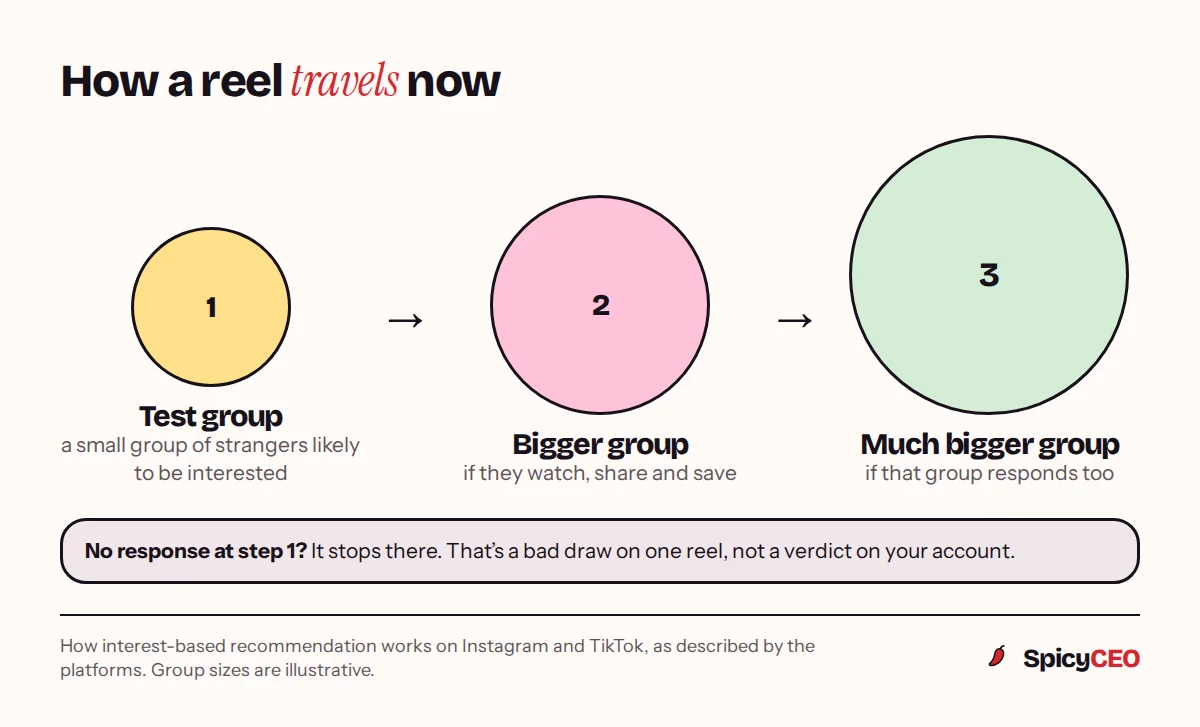
Now reach is decided post by post. A new reel is shown to a small group of people the system thinks might like it. If they watch, rewatch, share and save, it goes to a bigger group, then a bigger one. If they swipe away, it stops. The first few hundred viewers effectively vote on whether the next thousand see it.
That’s why the same account can post twice in one week and get 100 views on one reel and 100,000 on the other. The system is working exactly as designed.
And the test happens faster than it used to. Meta told investors that same-day posts now make up more than 30% of recommended Reels on Instagram and Facebook, more than double a year earlier, because new posts are now understood and recommended much sooner after publishing.
So every reel is its own lottery ticket. Posting more isn’t about looking busy. It’s about buying more draws. Some creators who grow fast on Instagram reportedly post anywhere from ten to fifty trial reels a day. You don’t need to do that. But one reel a week is one draw a week, and that’s not a strategy.
4. Why a clear subject beats pretty footage
A system that matches content to interests has to understand what your content is about first. That’s getting better fast, and it rewards clarity.
A video of you walking to a nice song is very hard to classify. What is it about? Who should see it? A video of you talking to the camera about a specific thing is easy: the words can be transcribed, the topic is obvious, and the system knows exactly who to show it to. That’s a big part of why talking-head videos have taken over Reels.
For now, a fuzzy reel can still get lucky, because the matching is forgiving. As the system gets smarter, vague content loses. The creators who do well over the next couple of years will be the ones whose reels have an obvious subject. You can start making that change this week, for free.
5. Five things to change about your reels
1. One subject per reel, obvious in the first second. If a stranger can’t tell what your video is about almost instantly, neither can the small test group deciding whether it travels. Say it, show it or put it on screen straight away.
2. Write captions for strangers. Your caption used to be an inside joke with your followers. Now it’s one of the strongest signals of what the post is about, read alongside your audio and on-screen text. Write it so someone who has never seen you understands the topic.
3. Pick a few content pillars. A single-topic account is the easiest to match. But because every reel is judged on its own, you can cover several topics as long as each reel is clear. For most creators, three to five pillars works: a few interests that attract the kind of person you want as a fan.
4. Read low views as a bad draw, not a verdict. A reel that didn’t travel tells you about its first few seconds: the hook wasn’t strong enough or the subject wasn’t clear. It doesn’t mean people don’t like you, that you’re shadowbanned or that Instagram is over for you. It’s the same lesson as watching views instead of upvotes on Reddit: judge the system by the right number.
5. Give your followers a new job. This is the one that protects your income, so it gets its own section.
6. The content that grows you isn’t the content that pays you
In the social era, growth and income were one loop: followers gave you reach, reach gave you more followers. Now they’re two separate machines that sit next to each other on your profile.
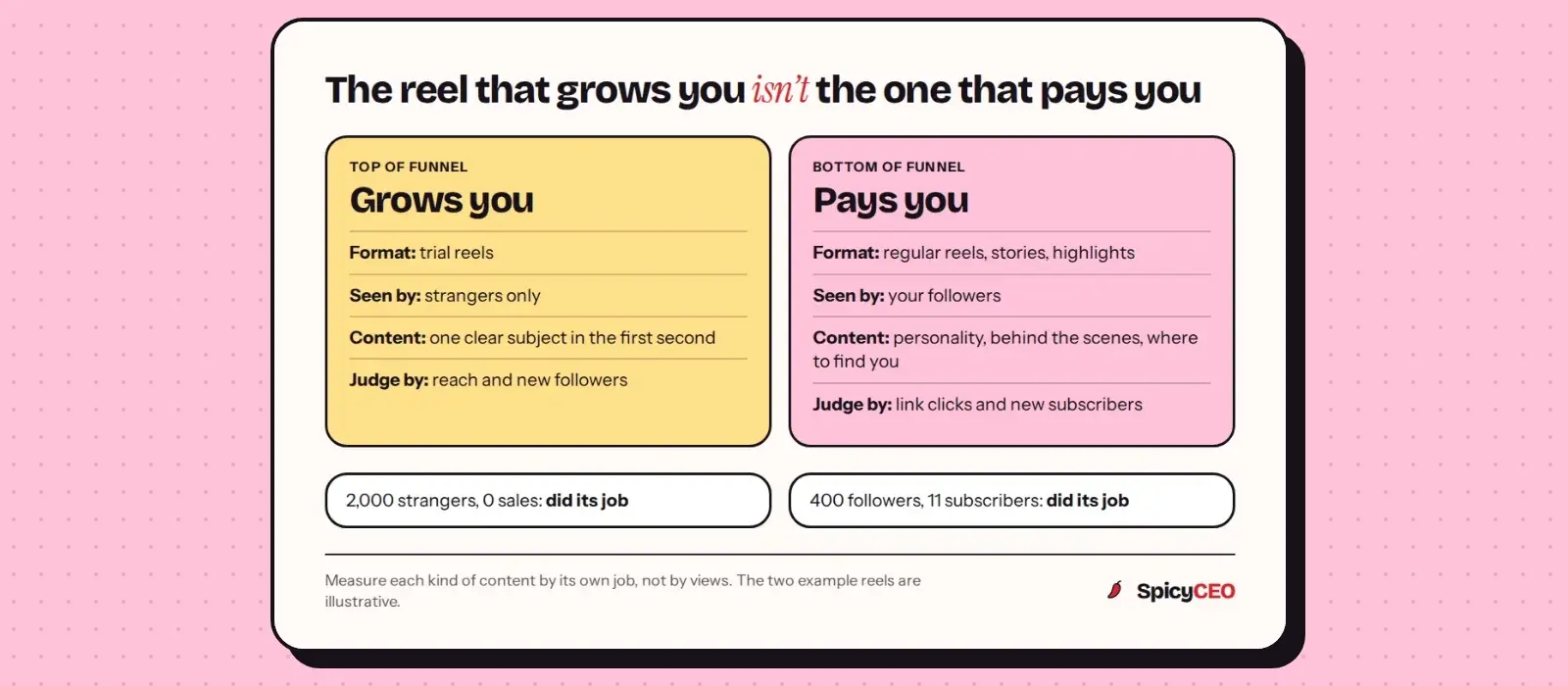
- The interest graph brings strangers in. That’s top-of-funnel content. Its job is to reach new people and get a follow.
- Your followers are where the money is. That’s bottom-of-funnel content. Its job is to make people who already like you click the link in your bio, your story or your highlights.
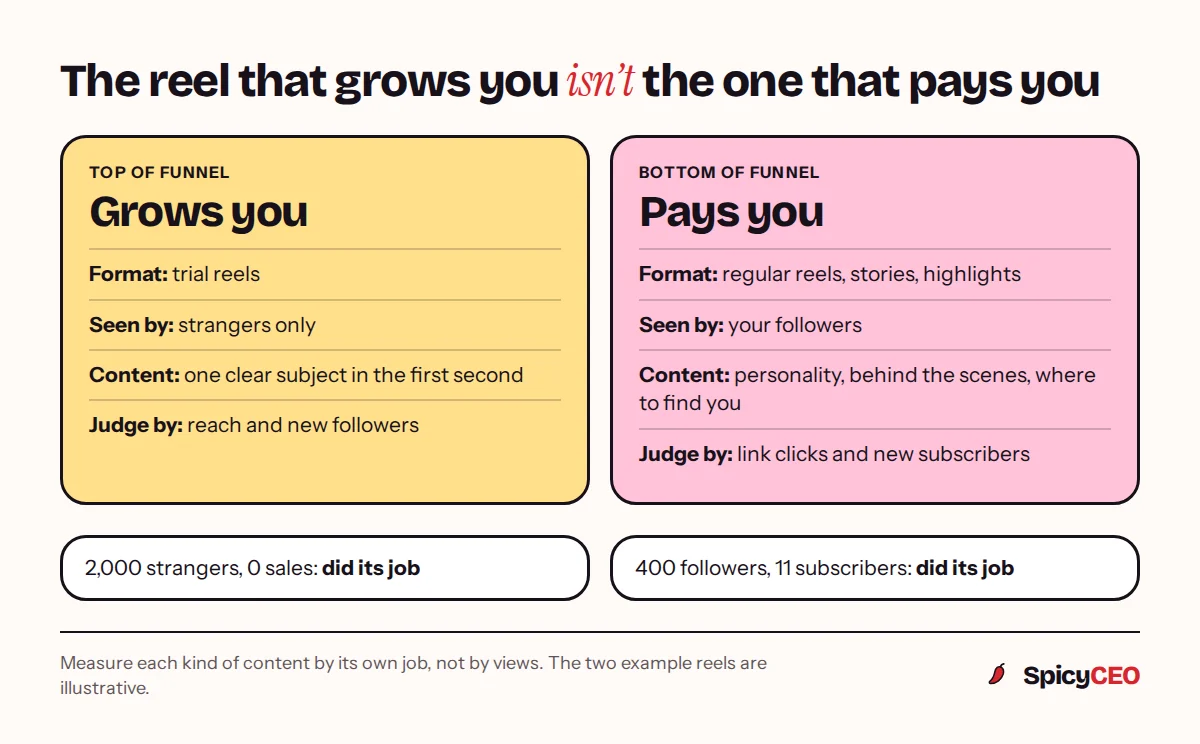
Picture two reels. One reaches 2,000 strangers and sells nothing. The other reaches 400 people who already follow you and brings in 11 subscriptions. Both did their job. Grade them on the same view count and you’ll drive yourself mad, and probably stop making the one that pays.
So split your calendar. Some of what you make is aimed at the machine: clear, one-subject reels for strangers. The rest is aimed at your followers: personality, stories, behind-the-scenes and gentle reminders of where to find more of you. If you also run separate SFW and spicier accounts elsewhere, it’s the same logic as in the X promotion guide: different content for different jobs.
Natalia’s take
I love this split because it’s just a funnel, and funnels are the one thing I was trained in before any of this. Strangers at the top, fans at the bottom, a clear next step in between. Measure each stage by its own number. And keep everything on Instagram itself firmly SFW: the account is the front door, not the shop.
7. How Instagram trial reels fit in
Trial reels are the purest version of the interest graph. You turn on the trial option before sharing, and the reel is shown to people who don’t follow you. It stays off your profile and out of your followers’ feeds. There’s no social part at all, just interest matching.
That makes them perfect for top-of-funnel testing:
- You can test without cluttering your profile. Followers mostly won’t see your experiments, so a flop costs you nothing.
- You get clean data. Instagram shows trial insights within about a day, so you can see which subjects and hooks reach strangers.
- Winners can go to your followers too. You can share a strong trial reel to your followers afterwards, or let Instagram do it automatically when it performs well.
- There’s a small entry bar. You need a public account that’s eligible for recommendations; as of 2026, professional accounts need around 200 followers. Check the current requirements in your app.
Instagram’s own guidance has changed a few times since trial reels launched in December 2024, so treat any exact numbers as “as of now”. The principle doesn’t change: test for strangers, convert followers.
8. A simple weekly plan
- 01Pick three to five content pillars that attract the fans you want. Write them on a sticky note.
- 02Make trial reels for growth: one subject each, stated in the first second, with a caption a stranger understands. Start with one to three a day if you can, more once it’s routine.
- 03Post personality content to followers: stories, regular reels and highlights that show who you are and remind people where your link is.
- 04Track the right numbers: new followers for trial reels; link clicks and new subscribers for follower content.
- 05Once a week, share your best trial reels to your followers and turn your best subjects into more trial reels.
Keep everything on Instagram clearly SFW and check your bio link setup, because a flagged link undoes all of this. More on that in the link-in-bio guide.
Quick questions
What are Instagram trial reels?
Reels that Instagram shows only to people who don’t follow you. They stay off your profile and out of your followers’ feeds unless you share them later or Instagram auto-shares a well-performing one.
Do trial reels hurt my account if they flop?
No. Your followers mostly don’t see them, so a weak trial costs you nothing beyond the time it took to make. A low view count just means that subject or hook didn’t work for that test group.
How many trial reels should I post?
As many as you can make well. Each reel is a separate chance to reach new people. Some fast-growing creators post many a day; one to three a day is a realistic start.
Does follower count still matter on Instagram?
Not for deciding what gets recommended. Followers matter as the people most likely to click your link and pay, so look after them with personal content.
Why did my reel get 100 views when the last one got thousands?
Each reel is tested separately on a small group of strangers. If they don’t respond in the first seconds, it stops there. Make the subject clearer and the hook stronger, then try again.
Sources
- Meta: First Quarter 2026 Results Conference Call transcript (April 29, 2026)
- TikTok Newsroom: How TikTok recommends videos #ForYou
- Creator Tribune: How Instagram trial reels work and who sees them
Platform features, eligibility and ranking change often; numbers are as published by Meta and TikTok or reported in 2026. Posting volumes are what some creators report, not a requirement. Keep all Instagram content within its community guidelines. Spotted a mistake? Email [email protected].