The short version
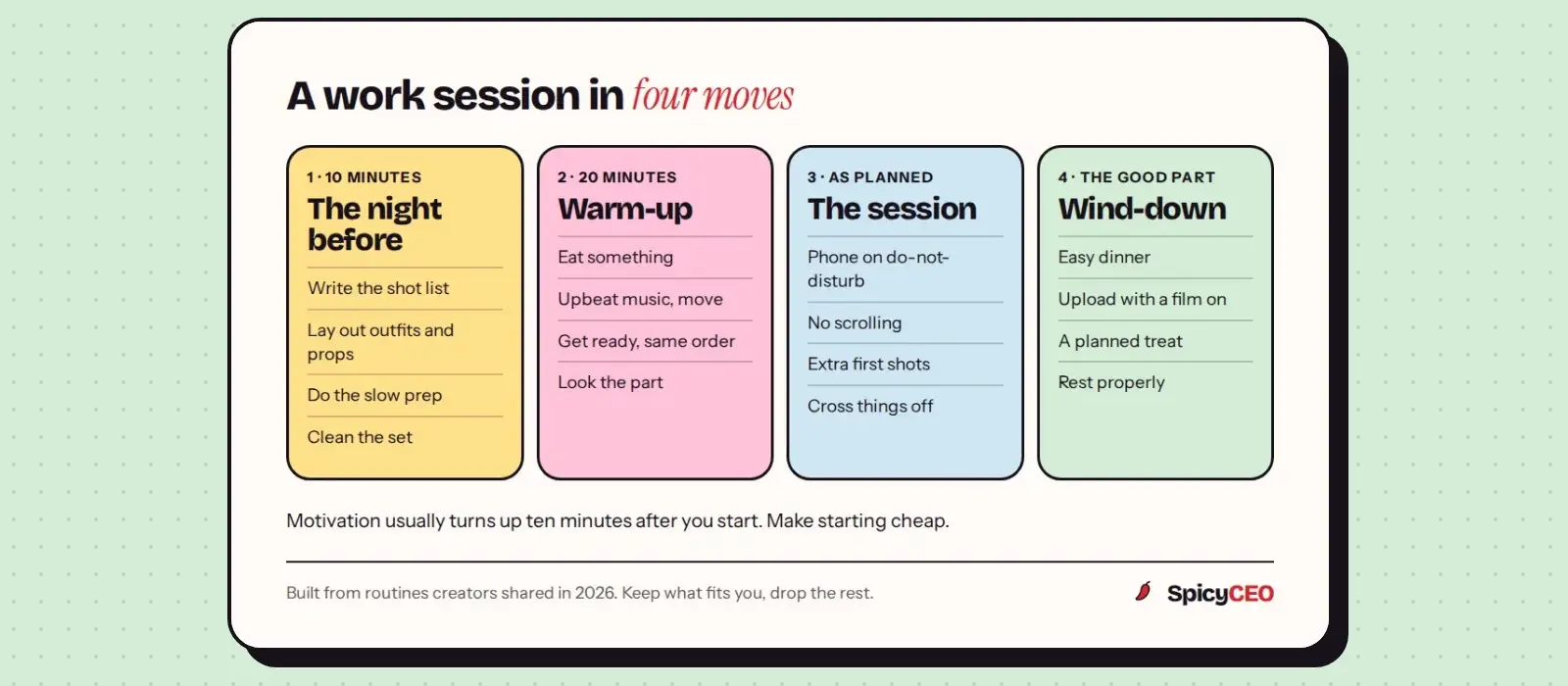
- You don’t need to be in the mood to work. You need to start. Motivation usually shows up ten minutes in.
- Most of the work that pays you isn’t filming at all: promo, messages, sales, numbers. None of it needs a mood.
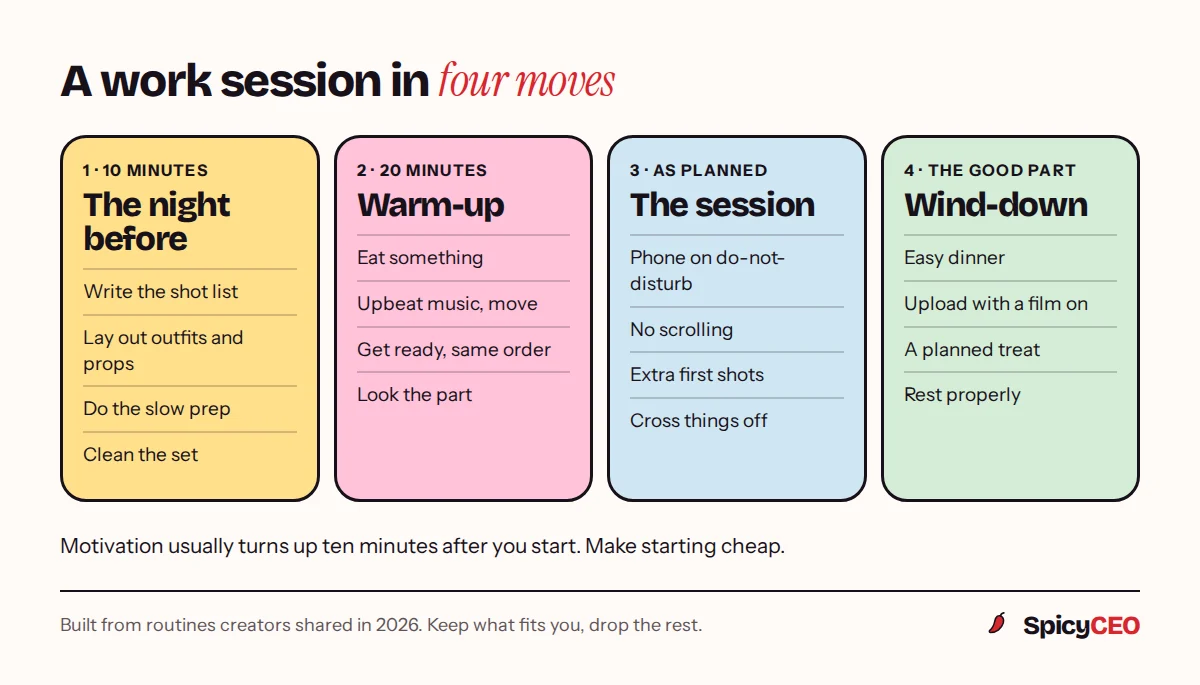
- Make starting cheap: plan the shots, lay out the outfits and do the slow prep the night before.
- A short warm-up ritual (music, getting ready, looking the part) tells your brain the shift has started.
- Protect the session: phone on do-not-disturb, no scrolling, food and water within reach.
- Plan the wind-down and a small reward. Finishing should feel good, or starting will keep feeling hard.
For six years I worked from home, mostly alone, on a job where nobody would notice if I didn’t turn up. Some days I was bursting with ideas. Most days I just had a list. The days I got the most done were rarely the days I felt like it.
So here’s the honest answer to a question creators ask all the time: how do you get into a work mindset when your schedule is a mess and the motivation isn’t coming? A lot of creators shared their rituals recently, and they ranged from playlists to mocktails to one very good point from a creator who’s been at this a while. I’ve put the best of them together, plus what worked for me.
1. You don’t need to be in the mood. You need to start.
The most useful answer came from a creator in her fifties who said, roughly: you don’t need to crave a burger to sell a burger. Your job is to understand what your customers like and deliver it convincingly. That’s performance and craft, not a feeling you have to wait for.
She also pointed out something every creator should tape to the mirror: most of the work that actually makes you money isn’t filming. It’s promoting, posting, messaging, selling, following up, checking what works and looking after your subscribers. None of that needs a mood. It needs a chair and a list.
Another creator put it even more simply: she doesn’t try to find a mindset first. She starts, and the mindset turns up once she’s moving. Unless she’s genuinely unwell, it works every time.
That’s the whole trick. Motivation is usually the result of starting, not the condition for it.
2. Make starting cheap: do the slow stuff the night before
Dread is usually about effort, not the work itself. If getting ready takes an hour before you’ve taken a single photo, of course you’ll put it off.
One creator’s routine was so well organised that I want to frame it. The night before a shoot she:
- Does the long prep (the slow shower and grooming) so the day-of shower is quick.
- Decides what she’s filming, the outfits and the order. She can still change her mind on the day, but she doesn’t start from a blank page.
- Keeps a private inspiration folder of poses and ideas she wants to recreate.
- Cleans the set: floor vacuumed, props clean and ready, so she can start the moment she’s dressed.
Another writes a to-do list for the session and admits that crossing things off feels great. It does. That little hit is cheap motivation, and you should use it.
If your schedule has gone sideways, this is also where batching helps. One planned session that produces a week or two of content beats seven anxious mini-sessions. Building that stockpile is the first habit in the first 90 days roadmap, and it’s just as useful in year three. The free content calendar generator plans your shoot days, posts and a day off in a minute.
3. A short warm-up ritual tells your brain the shift has started
Athletes warm up. Musicians tune. You can have a ritual too, and it doesn’t need to be long. What creators said works for them:
- Music, chosen on purpose. Lots of creators start with an upbeat, sing-along playlist to get their energy up, then switch to slower music once they’re actually shooting. One puts a certain pop song about working on repeat when she needs an extra push.
- Moving. Dancing around the room for a couple of songs came up again and again. It sounds silly. It works.
- Getting ready as the ritual. Several said fun makeup is where they switch on, sometimes with a few affirmations in the mirror. Another said looking the part is most of the mindset work: once the outfit is on, she’s in character.
- Talking to your regulars. One creator warms up by chatting to her loyal subscribers. It reminds her who she’s making the content for, and it’s money-making work too.
- Remembering why. One answer got a lot of love: log into your savings account. Nothing focuses the mind like seeing your goal grow.
The ritual matters less than the repetition. Do the same few things in the same order and, after a few weeks, your brain starts switching into work mode on its own.
Natalia’s take
My warm-up was boring and it worked: coffee (too much, as always), a walk with Biscuit, then the list. If it wasn’t on the list, it wasn’t work. And I chose the time in advance, like a client meeting. You don’t cancel a client because you’re not in the mood. It’s a business. Run it like one.
4. Protect the session
Once you’ve started, the biggest threat is your phone. The creators with the best routines were strict about it:
- Phone on do-not-disturb for the whole session, except the apps you need.
- No scrolling on shoot days. One creator said if she opens social media first, the session is gone.
- Eat first. Being hungry makes everything feel harder. A light meal and something you like keeps you going.
- Drinks within reach. A big bottle of iced water and something nice. One creator makes herself a mocktail with fruit juices, ginger ale, lime and mint, which feels like a treat without the downsides.
5. Expect the first pancake
One creator calls her first few photos the first pancake: they never come out right. So she takes extra at the start until she’s in the zone, and doesn’t judge the session by them.
That’s a healthy way to see it. The first ten minutes of any session are a warm-up, not a verdict on how good you are. Keep going and the good shots come.
6. Watch your crutches
A few rituals came with honest warnings from the creators themselves:
- Energy drinks. One creator said she’s now conditioned herself to need one before every custom. Caffeine is fine; needing it to work is a habit worth breaking. (Says the woman with the coffee problem.)
- Alcohol. One creator has a small glass of something sparkling when she’s struggling to loosen up. If that works occasionally, fine. If you can’t work without it, that’s a sign to look at, not a routine to keep.
- Warming up for so long that the session never happens. Some creators said their personal warm-up backfires and eats the energy they needed for the shoot. If your ritual regularly replaces the work, shorten it.
A ritual should make starting easier. If it makes you dependent on something, or quietly replaces the work, change it.
7. Plan the finish, not just the start
The part most people skip: what happens after. The creator with the night-before routine finishes every session the same way. She orders a nice dinner or heats up something easy, and watches a film while she uploads.
Another plans a small treat as a reward before she starts. And a creator who films physically demanding content treats her sessions like a hard workout: get it done, then look after yourself properly.
That’s not indulgence. If every session ends with you exhausted and feeling flat, your brain learns to avoid the next one. If it ends with food, rest and a little reward, starting gets easier each time.
8. When it’s more than a slump
Sometimes the problem isn’t motivation. If you’re dreading every session, can’t focus for weeks, or feel numb about work you used to enjoy, that’s worth taking seriously. Burnout is real in this job: you’re the product, the marketer and the customer service team, usually alone.
A few things that help:
- Schedule days off like appointments. Real ones, with no messages.
- Batch your content so a bad week doesn’t mean an empty page.
- Talk to someone. A friend who knows what you do, a creator group you trust, or a doctor or therapist. If focus has always been hard for you, as one creator with ADHD mentioned, a professional can help with that too.
You can’t run a business on an empty tank. The routine is there to make the work easier, not to push you through things you shouldn’t be pushing through.
Quick questions
How do I get motivated to create content when I don’t feel like it?
Start before you feel ready. Pick the easiest task on your list and do it for ten minutes; motivation usually follows. Planning the session the night before makes starting much easier.
Do I need to be in the mood to film?
No. Many experienced creators say content is performance, and most of the work that pays you, like promo and messaging, needs no mood at all.
What should a pre-shoot routine include?
Something that gets your energy up (music or moving), getting ready in the same order each time, your phone on do-not-disturb, and food and water nearby. Keep it short so it doesn’t replace the work.
How do I stop procrastinating on content days?
Decide what you’ll film, in what order, the night before. Lay out outfits and props. Don’t open social media until the session is done.
Is it burnout or just a bad week?
A bad week passes. If you’ve dreaded every session for weeks, can’t focus, or feel numb about work you used to enjoy, take a real break and talk to someone you trust or a professional.
About this article. Routines are examples creators shared about their own work in 2026; take what fits you. This is general guidance, not medical or mental health advice. If you’re struggling, please talk to a doctor or someone you trust. Spotted a mistake? Email [email protected].