The short version
- Treat it as a business from day one: research, a plan, a schedule and a spreadsheet.
- Your niche is what you’re known for, not what you look like. You find it by posting and paying attention.
- Set your page up like a shop window: bio, banner, pinned posts and welcome message all matter.
- Don’t start at the cheapest price. Cheap attracts the people least likely to spend.
- Month one is habits, month two is testing, month three is doubling down on what works.
- Protect your privacy and your head. Both are much harder to fix later.
When I opened my page in 2017, I treated it like a client account from the agency I’d just left: a plan, a posting schedule and a spreadsheet. My first year was still slow, and I still underpriced. But the habits I built in those first three months are the reason there was a second year.
Most people who open a page quit within a few months. Not because they aren’t attractive enough, and not because the market is “too full”. They quit because they treated it like a hobby and expected business results. Your first 90 days on OnlyFans are where you decide which one this is.
Here’s the plan I’d follow if I were starting again today.
Before day one: do the boring research
Spend a week doing nothing but research before you post anything. It feels like procrastinating. It’s the highest-value week you’ll have.
- Study creators in your niche who are doing well. How do they write their bio? What do they post for free, and what’s behind the paywall? How do they price? What do their promo posts look like?
- Read the advice communities. Experienced creators give away a ridiculous amount of knowledge for free. Search before you ask.
- Decide your boundaries now, while you’re calm: what you will and won’t make, and what you’ll never do for any price. It’s much easier than deciding mid-conversation with a fan.
- Set up your privacy. A separate email, phone number and bank account, and a creator name that isn’t yours. Separate phone, email, bank and name from day one. I learned this one the hard way in 2020.
Find your niche (it isn’t what you look like)
“Curvy”, “petite”, “fit guy”, “college girl”: these aren’t niches. They’re categories, and millions of creators are in them. A niche is what you’re known for. It’s the thing someone says when they describe you to a friend.
A good niche sits where three things meet: what you enjoy making, what your audience wants, and what isn’t already dominated by big creators. A crowded category gets much less crowded when you add one specific thing. And a specific niche gives you specific places to promote, like gaming, fitness or cosplay communities that broad pages can’t reach. Here’s how to check how crowded a niche really is before you commit.
Don’t have one yet? Start anyway. Almost nobody plans their niche. They find it by posting different things and noticing what works: a prop, a setting, an outfit, a mood. Those patterns are data. Perfectionism at the start line is one of the most common reasons people never start.
Answer the one question that matters
Every decision you make, from your bio to your prices to your captions, comes back to one question: why would someone choose you, specifically?
If that question makes you squirm, good. That’s the most useful signal you’ll get this month. It doesn’t need a grand answer, just a specific one. “The girlfriend experience with real conversation.” “The anonymous creator who makes the mystery part of the fun.” If someone can describe you in one sentence, your marketing gets about ten times easier.
Set up your page like a shop window
A potential subscriber decides in seconds. Everything they see has to answer “what do I get?”
- Bio: say what they’ll get, how often you post, how you interact, and what makes you different. “Hey, come check out my page!” says nothing.
- Profile picture and banner: good light, clean background, on-brand. You don’t need a studio. You do need to look like you care.
- Pinned posts: pin your best posts, not your newest. They’re your whole argument for subscribing.
- Welcome message: warm, personal, and useful. Thank them, tell them what’s coming, and mention customs or extras gently.
Price like you mean it
Almost every beginner starts at the lowest possible price, hoping volume will make up for it. It doesn’t. Very cheap pages attract the people least likely to tip, buy pay-per-view or stay past month one. You work just as hard for a fraction of the money, and that’s the fastest route to burnout.
There’s no single right price. But it’s usually better to start at a fair price with a first-month discount for new subscribers than to start at the bottom with nowhere to go. And remember that the subscription is rarely where most of the money is: pay-per-view, customs and tips usually are. A subscriber who paid a fair price has already shown they’ll spend. If you need convincing, read why most creators underprice, and how to raise your prices.
Days 1–30: build the habits
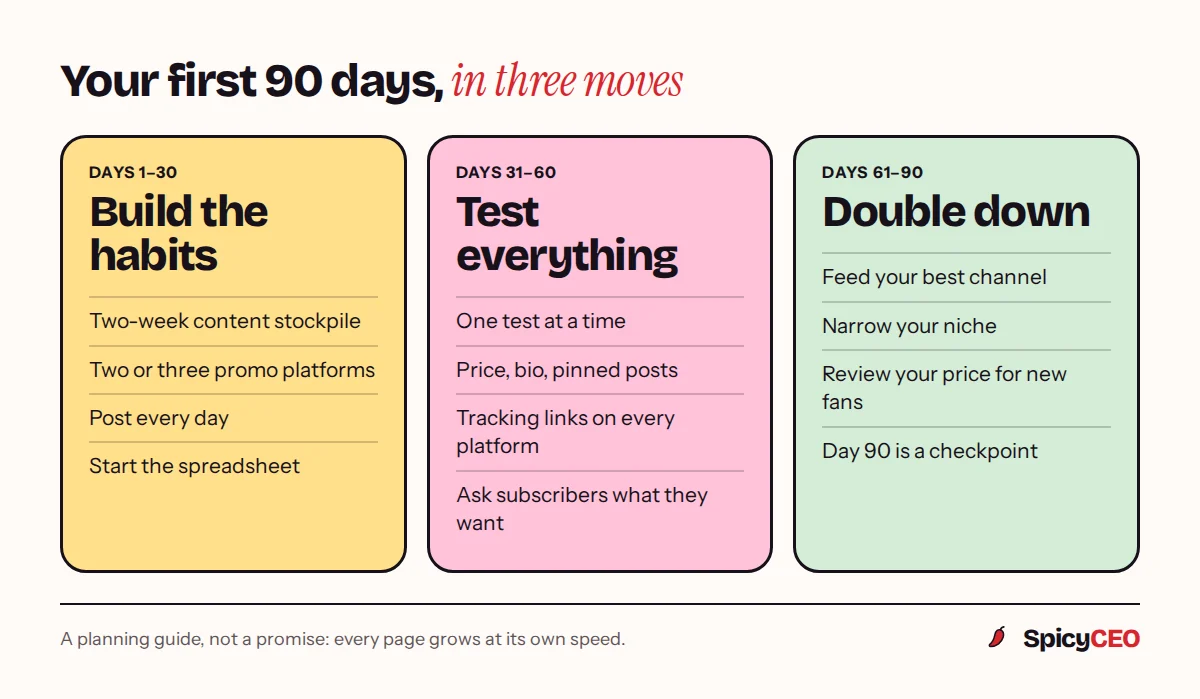
Month one isn’t about subscriber numbers. It’s about systems.
- Build a content stockpile of at least two weeks before you start promoting. Nothing is worse than finally getting a subscriber and having nothing new to show them.
- Pick two or three promo platforms, not six. Choose the ones that fit your strengths: short video, photos and captions, or communities.
- Make every profile point somewhere. A link in your bio, posts that create curiosity, captions that hint at what’s behind the paywall.
- Post every day on your page and your promo platforms. It tells both the algorithms and your visitors that you’re active.
- Start your spreadsheet: posts, new subscribers, where they came from, and revenue. Ten minutes a day.
Days 31–60: test everything
This is where the business starts. Now you have a little data, so stop guessing.
- Test one thing at a time. Your price for two weeks, then a different one, and compare total revenue, not just subscriber count.
- Test your bio: a playful version against a direct one. Which turns more visitors into subscribers?
- Test pinned posts, captions, mass-message prices and your first-month discount.
- Use tracking links so you know which platform actually sends people.
- Listen to your subscribers. Ask them what they want more of, and notice what they open, buy and ignore.
Days 61–90: double down
- Feed your best channel. If one platform brings most of your subscribers, give it most of your time.
- Narrow your niche. The patterns from the first two months are your niche taking shape. Lean in.
- Review your price. If you started low, month three is a natural time to raise it for new subscribers. You now have a page full of content and a clearer offer.
Natalia’s take
Day 90 isn’t a finish line, it’s a checkpoint. Ask yourself one honest question: do I know what works, and am I doing more of it? If yes, keep going. If you’ve been doing the same thing for weeks with no results, that isn’t persistence. Change one thing and measure it.
The worries every beginner has
“I’m not attractive enough”
This holds back more people than anything else, and it’s wrong. People pay for personality, connection and feeling like they know you. There’s an audience for every body, every age and every style. What changes everything is framing: hide something like a flaw and your audience feels the insecurity. Own it as part of who you are and it becomes character.
“I want to stay anonymous”
Completely doable. I don’t show my face here either, and plenty of creators build whole careers that way. You have to work harder on everything else: your caption voice, your niche, your style and props, and the mystery itself. Crop or angle your shots, check your photos for anything identifying, and choose promo platforms where faceless creators do well.
“It’s been two weeks and I have nobody”
Two weeks is not enough to judge anything. Plenty of successful creators waited weeks for their first subscriber. Check the foundations instead: are your promo profiles active, are you posting daily, is your page set up properly, and is there a clear path from your posts to your page? If yes, keep going. If no, that’s your to-do list.
“The technical side is overwhelming”
Pay-per-view, mass messages, tracking links, link pages, promo rules: the learning curve is real. Don’t try to learn it all this week. Learn one thing a day. Thirty minutes every morning is 45 hours of learning over 90 days, which is more than most people put in during their whole first year.
Protect your head
This work is emotionally harder than people expect. Watching your stats, slow growth, comparing yourself to others, and the worry of being recognised add up fast. On days when you can’t get started at all, this work-mode routine helps.
- Set working hours and stick to them. Schedule days off like appointments.
- Celebrate small wins: your first subscriber, first tip, first lovely message.
- Stop comparison scrolling. You’re seeing other creators’ highlights, not their slow months.
- Batch your content so a bad week doesn’t mean an empty page.
- Remember it’s genuinely hard. Difficulty isn’t a sign you’re failing. It’s the job.
Your 90-day checklist
- Week 0Research a week, set boundaries, separate your identity: email, phone, bank, name.
- Days 1–30Two weeks of stockpiled content, two or three promo platforms, daily posting, a simple tracking spreadsheet.
- Days 31–60Test price, bio, pinned posts and captions one at a time. Tracking links on every platform. Ask subscribers what they want.
- Days 61–90Put most of your time into your best channel, narrow your niche, review your price for new fans.
- AlwaysTreat it like a business, protect your privacy, and take your days off.
Quick questions
How many subscribers should I have after 90 days?
There’s no honest single number. It depends on your niche, your promotion and timing. A better test: do you know where your subscribers come from, what they buy and what you’re known for? If yes, you’re on track.
Should I start with a free or a paid page?
Both can work. A free page with pay-per-view suits creators who are good at messaging and teasers; a paid page suits steady posting. Whichever you choose, test it and compare total revenue.
How much content do I need before launching?
At least two weeks of posts ready to go, plus enough on your page that a new subscriber sees something worth paying for straight away.
How many promo platforms should I use at first?
Two or three. Learn them properly, then add more once one is working.
Can I succeed without showing my face?
Yes. It takes more work on your niche, captions and personality, but plenty of faceless creators do well. Make the mystery part of the brand.
About this article. General education, not business, financial or legal advice. Results vary widely with niche, effort and timing. Platform rules change, so always check the current terms. Spotted a mistake? Email [email protected].