The short version
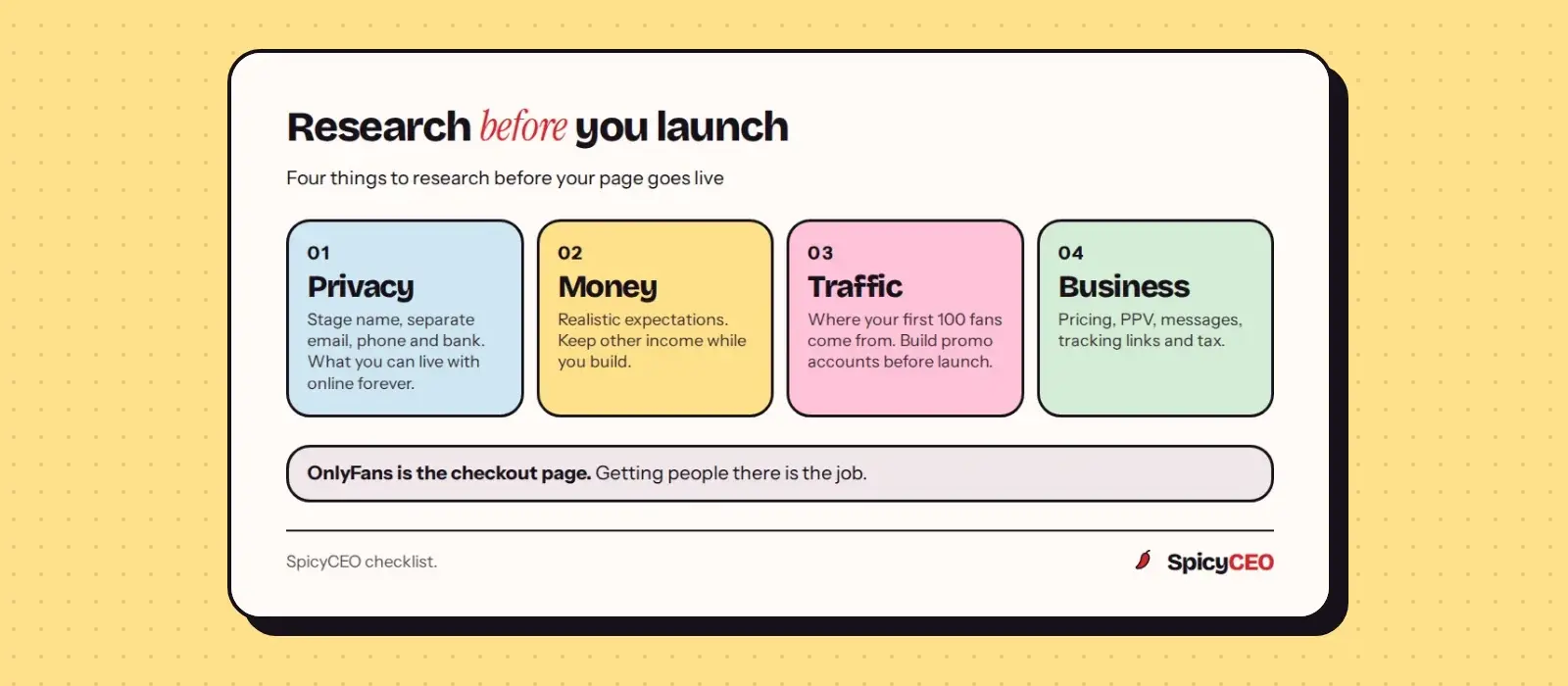
- OnlyFans brings you almost no traffic. It’s the checkout page. Your real job is getting people to it.
- Before starting an OnlyFans, decide what you can live with being online forever, and who might find it.
- Most creators earn modest amounts. The life-changing stories are real, but they’re the exception the headlines are built on.
- You don’t need an existing following, but you do need a promotion plan. Many creators build their socials for a few weeks before launching.
- Learn the business basics first: pricing, free vs paid pages, pay-per-view, messaging, tracking and tax.
- Avoid the shortcuts that target beginners: agencies that find you, DM bots and burner accounts, and taking payments off the platform.
Every week, new creators post the same thing in advice communities: “I opened my page a week ago and I have zero subscribers. What am I doing wrong?” Usually nothing, except skipping the step before. The page went live before the plan did.
This guide is the plan. It’s everything worth researching before starting an OnlyFans, or any subscription fan site: what to decide about privacy, what to expect from the money, where your fans will actually come from, and which beginner shortcuts cost more than they save. It’s not here to talk you out of it. Plenty of creators build real businesses. They just rarely do it by accident.
1. Why research before starting an OnlyFans
Here’s the thing almost nobody explains up front: OnlyFans is the checkout page, not the shop window. The platform has no real discovery feed. People don’t browse it and stumble onto you. Nearly every subscriber you’ll ever get arrives because you sent them there, from Reddit, X, Instagram, TikTok or somewhere else.
So a page that goes live without a promotion plan is a shop with no street. That’s why creators who open an account on impulse so often end up asking why nothing is happening. Experienced creators say the same thing again and again: it’s a business, and you need to treat it as one before day one, not after month three.
The good news: you don’t have to work it out alone. Creator communities have years of answers to almost every beginner question. Search before you ask. Someone has asked it before, and the best answers are usually already there.
2. Privacy and permanence: decide this first
Before money, before promotion, ask yourself the hard questions:
- Can you live with this being online forever? Anything you upload can be saved, shared and leaked, even if you delete it later.
- Who might find out? Family, friends, a current or future employer. Decide now how you’d handle it, rather than in a panic later.
- Will it affect your career or other plans? Some jobs and industries are less forgiving than others. Think five years ahead, not five weeks.
- Faceless or not? Plenty of creators never show their face. It’s a real option, with its own trade-offs in how you promote.
Then set up your privacy before you post anything: a stage name, a separate email, a separate phone number, a separate bank account, and photos with no location data (the free photo location remover strips it out). It’s far easier to start private than to become private later.
3. Set honest expectations about money
The stories you see are the outliers: the creator who quit her job and made a year’s salary in a month, the reality star who made thousands in a weekend. They get written about precisely because they’re unusual. What doesn’t get written about is the far larger group earning a little, or close to nothing.
Creators who’ve been at this for years are blunt about it. Some say it took them four years to reach the point where the income could pay their bills. Others reached the top few percent within three months, including creators who started in their forties with no following. Both are true, and the gap between them is mostly promotion, niche, consistency and a good dose of luck.
Plan for the realistic middle. Treat your first months as building, not earning, and keep your other income until the numbers say otherwise. When the platform announces how many creators became millionaires, read the number that actually matters before you get excited.
Natalia’s take
I started in 2017 with a debt of about 18,000 to pay off and five years of agency marketing behind me, and I still underpriced everything in my first year. A marketing background didn’t save me from beginner mistakes. Research is how you make the cheap mistakes on paper instead of the expensive ones on your page. Your exit plan starts on day one, and so does your research.
4. Research your traffic before your content
If OnlyFans is the checkout page, your socials are the street. So the most useful research question is: where will my first 100 subscribers come from?
You don’t need an existing following. Many successful creators started with brand-new accounts and no audience at all. But they all learned to promote, and it took them time. A common approach is to build your promo accounts for a few weeks before launching, so there’s someone to tell when the page goes live.
What to research for each platform you’re considering:
- The rules: what’s allowed, what gets posts removed, and how accounts get limited or shadowbanned.
- How new accounts are treated: many communities require account age or karma before you can post.
- What content works there: safe-for-work teasers, short video, photos, conversation.
- How people get from there to your link: your bio, link-in-bio tool and pinned posts.
Reddit is where many creators start, because the right communities can send traffic without an existing following. Here’s how to run Reddit promo like a business. Some creators also argue that platforms with built-in discovery, such as clip stores or cam sites, are an easier first step if you have no audience at all. It’s a fair point: one platform is never a plan anyway.
5. Understand your funnel: clicks and conversion
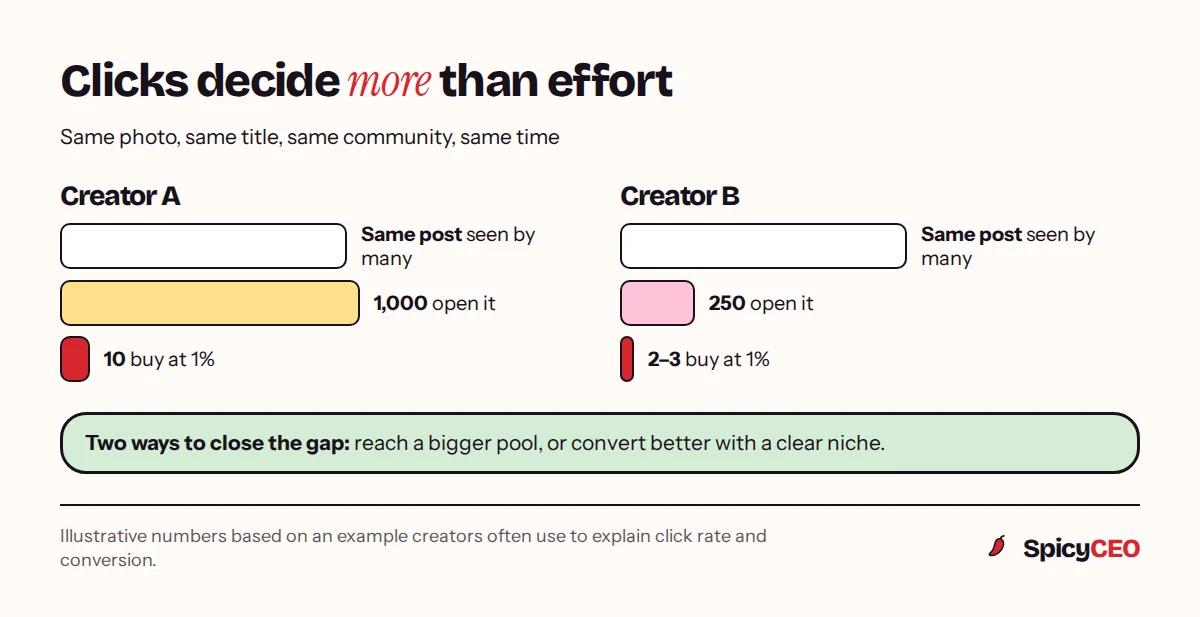
One experienced creator explained the maths of this business better than most courses. Imagine two creators post the same photo, with the same title, in the same busy community, at the same time. If one gets 1,000 people to open the post and the other gets 250, and both convert 1% into buyers, the first has 10 new customers and the second has 2 or 3.
The difference isn’t effort. In mainstream spaces, some looks simply get more clicks, and that isn’t fair, but it’s real. If you’re not the type most people click on by default, you have two ways to win:
- Reach a bigger pool: promote more often, in more places.
- Convert better: find the people who are specifically looking for you, through a clear niche and the communities that love it. A smaller audience that really wants what you offer converts far higher.
Put your own numbers into the free funnel calculator to see what reach you’d need for the income you want.
6. The business basics to learn before day one
You don’t need to master all of this before launching, but you should know what each one means:
| Topic | The question to answer |
|---|---|
| Pricing | What will you charge, and why? Free page or paid? |
| Pay-per-view (PPV) | What goes behind the subscription, and what’s sold separately? |
| Mass messages | How often will you message all fans, and with what? |
| Your bio and page | Does your page explain in seconds why someone should subscribe? |
| First-month offer | Will you launch with a discount or free trial? |
| Your content vault | How will you organise content so you can find and reuse it? |
| Tracking links | Which promo platform is actually sending subscribers? |
| Your statistics | Which numbers will you check every week? |
| Taxes | How much of every payout will you set aside? |
| Agencies | Do you understand what they take before anyone pitches you? |
And on the content side: solo or collaborations, how often you’ll film, batching, lighting, storage, and where you’ll buy outfits and props. If this table feels like a lot, our first 90 days roadmap puts it in order.
7. Beginner shortcuts that backfire
New creators are a target market of their own. Watch for these:
Agencies that find you. If an agency contacts you within days of opening your page, that’s a sales funnel, not luck. Some creators suspect a few of the “I’m brand new, help!” posts in beginner communities are agencies fishing for leads. Before talking to any of them, read about the contract clauses that cost creators the most.
DM bots and burner accounts. Some tools promise to send hundreds of automated messages a day from fake accounts. Mass unsolicited messages and fake accounts break the rules of most social platforms, and they get accounts banned. The traffic it brings isn’t worth losing the account it came from.
Taking payments off the platform. Selling through DMs with payment apps can look simpler, with no platform cut. But you lose the age verification, chargeback protection and content protection a fan site gives you, and it can break the rules of the platforms you promote on.
Buying followers or engagement. It inflates numbers that don’t buy anything, and it can damage your reach.
8. Build your own playbook
The best advice from experienced creators isn’t a tactic. It’s a habit: keep your own rulebook. One creator keeps a simple document of the practices that work for her. When something stops working, she researches, tests something new and updates the document, keeping the old rules at the bottom so she can see how her strategy has changed. Over time, it even showed her the seasonal patterns in her own fan base.
You’ll find plenty of conflicting advice online, because different things work for different creators. A playbook turns that noise into your own data. Write down what you try, what happened and what you’ll do next. It’s dull. It’s also the difference between guessing and running a business.
- 01Decide your privacy setup: stage name, separate email, phone and bank, faceless or not.
- 02Set your money expectations: keep other income, and treat the first months as building.
- 03Pick one or two promo platforms and learn their rules before posting.
- 04Build those accounts for a few weeks before your page goes live.
- 05Learn the basics: pricing, PPV, messaging, tracking links and tax.
- 06Start a playbook on day one, and update it every week.
Quick questions
What should I know before starting an OnlyFans?
That the platform brings you almost no traffic, so promotion is the real job. Decide your privacy setup first, set realistic money expectations, pick your promo platforms and learn the basics of pricing, pay-per-view, messaging and tax before you launch.
Do I need a following before starting an OnlyFans?
No. Many creators start with brand-new social accounts. You do need to learn to promote, and it helps to build those accounts for a few weeks before your page goes live.
How long does it take to make money on OnlyFans?
It varies enormously. Some creators see meaningful income within a few months; others say it took years before they could live on it. Plan for slow growth and keep your other income at first.
Can I start an OnlyFans without showing my face?
Yes. Many creators are faceless. It can make promotion a little harder, but it protects your privacy, and a clear niche matters more than a face. Here’s how to check how crowded your niche is before you choose.
Should I sign with an agency when I start?
Be very careful. Agencies that contact brand-new creators are selling, and many take a large share of earnings. Learn the basics yourself first, so you know exactly what you’d be paying for.
About this article. Experiences and timelines are what creators report, and results vary widely. Always follow the rules of every platform you use. Spotted a mistake? Email [email protected].