The short version
- Your platform income is self-employment income. You owe income tax plus about 15.3% self-employment tax on your profit.
- You can deduct what you buy and use only for the business: props, lighting, equipment, editing, promo, courses. Keep the receipts.
- Clothing and makeup are the grey zone. The IRS rule is strict; get a professional opinion before you deduct them.
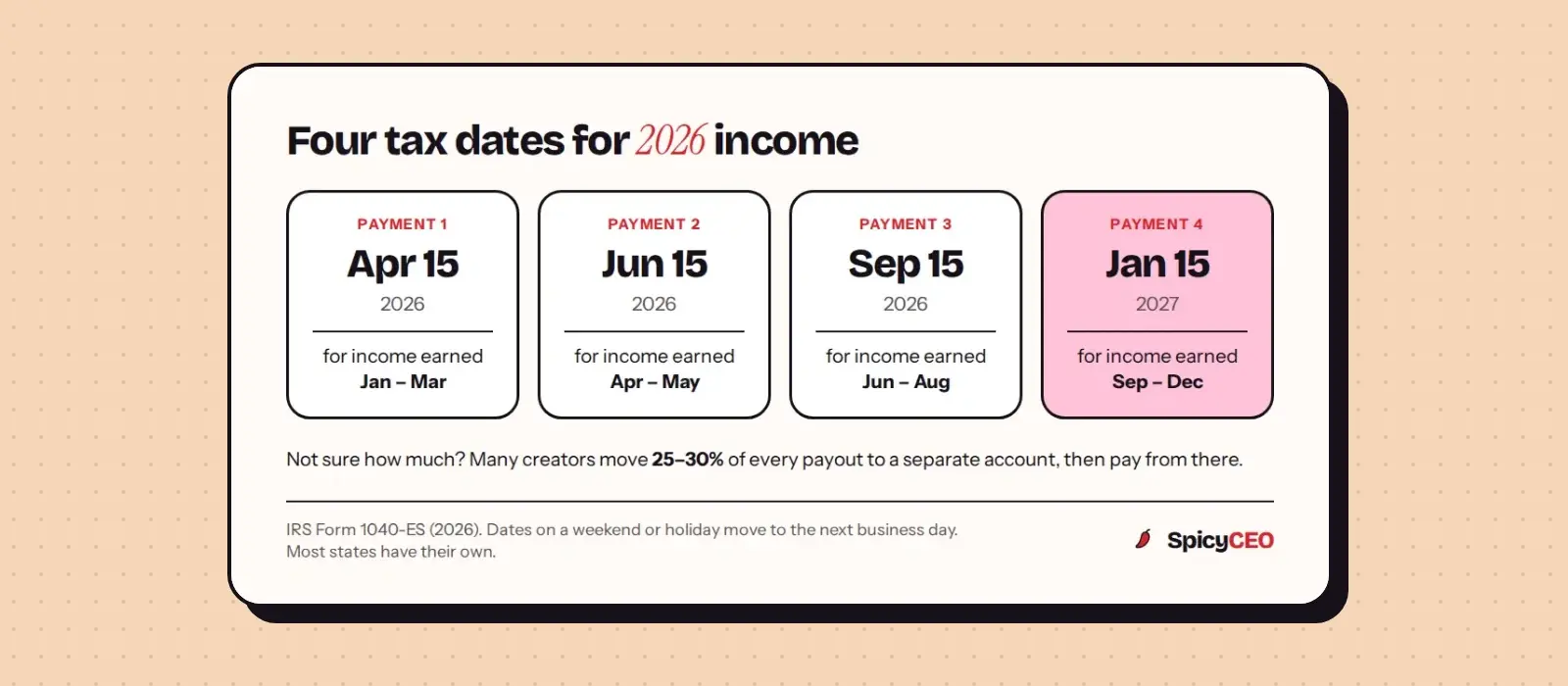
- Pay estimated tax four times a year. For 2026 income the last payment is due January 15, 2027.
- From 2026, platforms only have to send a 1099-NEC once they’ve paid you $2,000 or more. All your income is still taxable without one.
- An LLC is for legal protection, not a tax trick. An S corp can save tax, but only once your profit is high.
Taxes were the part of the job I understood least in my first few years. In 2021 I finally paid for a bookkeeping course, and it’s still the best money I ever spent. This is the guide I wish someone had handed me in year one.
I’m not an accountant, and this isn’t tax advice for your situation. It’s the map. Along the way I’ll share what a US CPA, who is also a creator, tells other creators, and I’ve checked every rule against the IRS as of 2026. OnlyFans taxes work the same way as taxes on Fansly, Fanvue or any other platform that pays you as an independent creator.
US only. Everything here is about US federal tax, with a nod to state rules. If you live elsewhere, the ideas (keep receipts, set money aside, pay on time) travel well, but the rules don’t. Canadian creators can start with the Canada Revenue Agency’s guide for self-employed people.
1. How OnlyFans taxes work: you’re a business, not an employee
Subscription platforms don’t employ you. They pay you as an independent contractor, so nobody is withholding tax from your payouts. In tax terms you’re a sole proprietor by default, and you report your income and expenses on Schedule C with your normal tax return.
Two taxes apply to your profit (income minus business expenses):
- Income tax, at your normal rate, federal and usually state.
- Self-employment tax: about 15.3% for Social Security and Medicare. An employer would normally pay half of this for you. Now you’re the employer. It applies once your net self-employment earnings reach $400 for the year.
That second one is why creators get caught out. The rough rule many people use is to set aside 25 to 30% of every payout. That CPA suggests the same kind of number. Your real rate depends on your income, state and expenses, so treat it as a starting point and adjust once you’ve done your first return. For your own number, try the free tax set-aside calculator.
2. What you can deduct
The test is simple to say and harder to apply: an expense has to be ordinary and necessary for your business. In plain words: something a business like yours would normally buy, that you bought to make money.
The CPA put it well: what matters is your intent when you buy something, and whether you could prove it in an audit. For creators that’s easier than for most businesses, because the photos and videos are the proof.
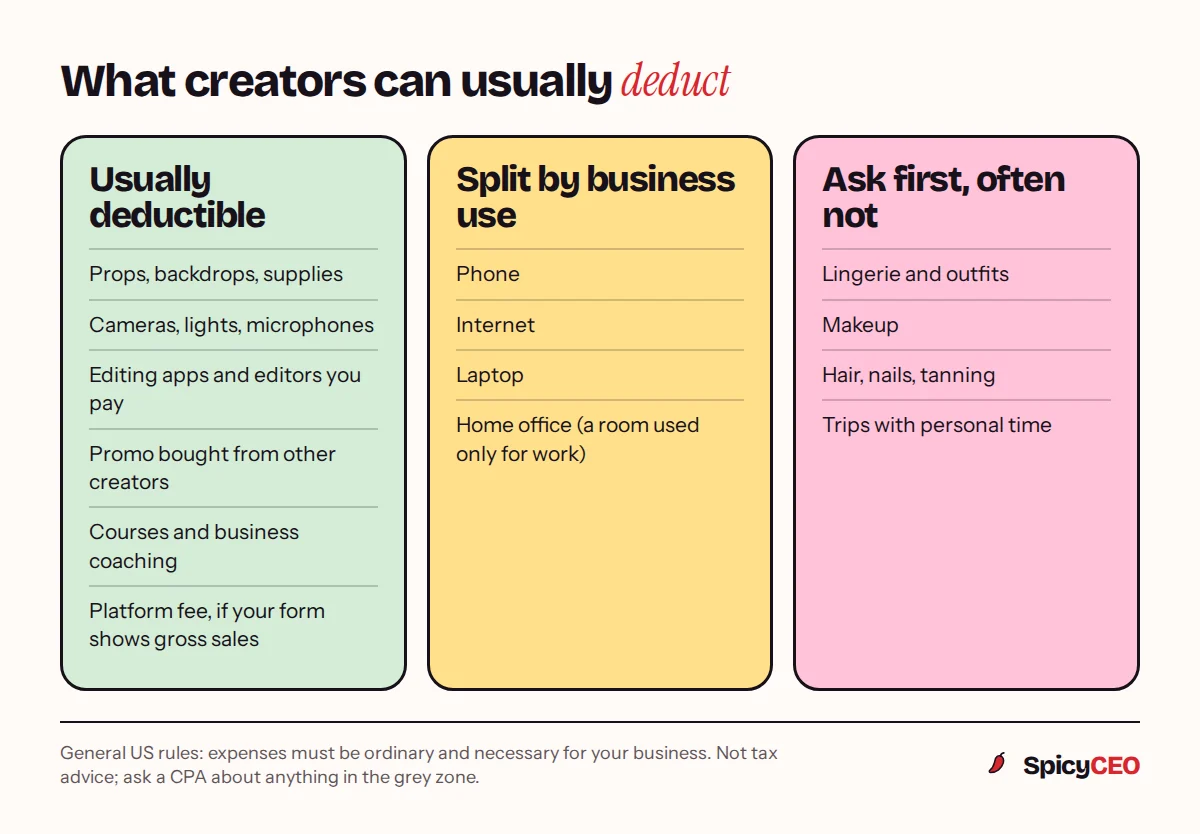
Usually fine when they’re used only for the business:
- Props and supplies: backdrops, toys, costumes used only for content. The CPA classed toys and similar items as supplies or props.
- Equipment: cameras, ring lights, tripods, microphones. Big items may need to be depreciated, which is one of the reasons to have someone do your return.
- Software and services: editing apps, a scheduling tool, a link-in-bio subscription, a chatter or editor you pay.
- Promotion: shoutouts or promo you buy from other creators. The CPA called this a legitimate deduction. Keep the invoice, or at least the transaction record from the platform.
- Learning: business coaching or a course about running your page counts as professional development.
Split by business use: your phone, internet and laptop are probably used for life too. Deduct the business share, at a percentage you could defend. A room used regularly and only for your business can qualify for the home office deduction; the simplified method is $5 per square foot, up to 300 square feet.
3. The grey zone: clothes, makeup and trips
This is where the internet is full of confident nonsense, so let’s be careful.
The IRS rule on clothing is strict: work clothes are deductible only if your work requires them and they aren’t suitable for everyday wear. That’s why gym clothes you show off on social media are a weak deduction, even though you’ve probably seen someone claim otherwise. Lingerie and outfits bought only for content are a stronger argument, but still one to run past a professional. Haircuts, nails and tanning are usually treated as personal grooming, so most tax guides say no.
The CPA-creator is more relaxed than many tax guides. She argues that makeup and outfits you buy specifically to make money, keep separate and don’t use in daily life could be deductible, and that items you also use personally can be partly deducted based on business use. Plenty of other tax professionals are stricter about clothing and makeup. When professionals disagree, that’s your sign to ask your own accountant before you claim it.
What helps your case either way:
- Keep business items separate. A drawer, a rail or a corner that’s only for content.
- Keep receipts and note what each item was for.
- Don’t deduct personal parts. On a trip, the content shoot days can be business; the sightseeing and your partner’s ticket are not, unless they’re working in the content too.
Natalia’s take
Tell your accountant the truth about what you do. One creator planned to give her accountant only totals, without saying what she bought. I understand the instinct, but an accountant who doesn’t know your business can’t defend your deductions. If yours would judge you, find another one. It’s a business. Run it like one.
4. Quarterly payments: the part that gets everyone
Because nothing is withheld, the IRS expects you to pay during the year, not just in April. These are estimated taxes, paid four times a year with Form 1040-ES or online. When you file your return, what you paid is subtracted from what you owe.
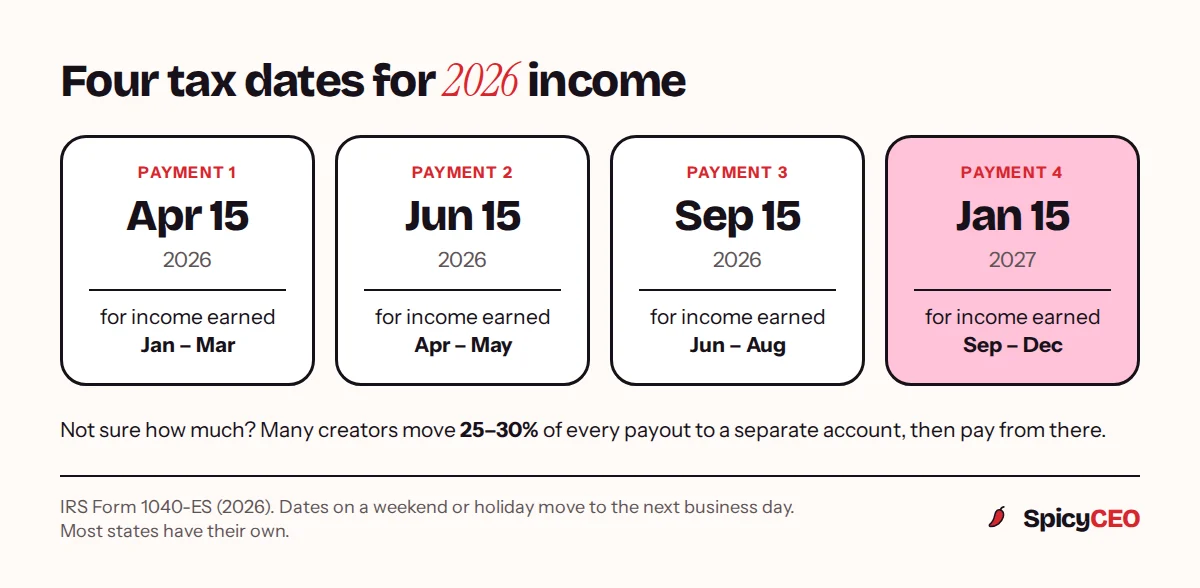
A few things the CPA cleared up:
- The periods aren’t equal. The second “quarter” is only two months.
- Small amounts: you generally don’t need to make estimated payments if you expect to owe less than $1,000 for the year after withholding. Being optimistic, it’s still a good habit.
- Have a day job too? You can raise the withholding on your paycheck instead. One creator asked exactly that, and the answer was yes: extra withholding through your employer counts towards your tax.
- How you save it is up to you. Move money aside every payout, every month or every quarter; whatever fits your cash flow. Many banks let you open a second savings account in a minute. I moved my tax share on payout day, every time, so I never had to decide.
If you’ve already missed one, don’t panic and don’t wait. Pay what you can now; penalties are calculated on how late and how much, so a late payment is better than none.
5. Forms you’ll get, and the 2026 change
Platforms report what they pay you on a 1099-NEC. The threshold changed: for payments made from 2026, a platform only has to send one once it has paid you $2,000 or more in the year (it was $600). From 2027, that number will rise with inflation.
Two things people get wrong:
- No form doesn’t mean no tax. Income below the threshold is still taxable, and you report it on Schedule C like the rest. Creators often ask whether they have to report a few hundred dollars that came without a form. Yes.
- Check what the form shows. Some creators asked whether their form shows the full amount fans paid or only what the platform paid out after its cut. Compare the number with your earnings statements. If it includes the platform’s share, that fee is a business expense. If it’s already net, don’t deduct the fee again.
Payment apps and card processors use a different form, the 1099-K, which is back to a threshold of $20,000 and more than 200 transactions.
6. Sole proprietor, LLC or S corp?
Everyone asks this. Here’s the honest version.
| Setup | What it changes | Worth it when |
|---|---|---|
| Sole proprietor | Nothing to set up. You report on Schedule C. | You’re starting out or earning modestly |
| Single-member LLC | Legal separation between you and the business. Taxed the same as a sole proprietor by default. | You want liability protection, or a business name on contracts and bank accounts |
| S corp (an election, often for an LLC) | You pay yourself a salary; profit above it can avoid self-employment tax | Your profit is high enough that the savings beat the extra payroll, filings and accounting fees |
The CPA’s view is that plenty of creators can run as sole proprietors, with less paperwork. An LLC makes sense if you want the legal protection. And state costs matter: California charges LLCs an $800 minimum franchise tax every year, plus an extra fee once income passes $250,000. Some professions have their own rules: one creator who also works in healthcare had been told her medical side business had to be an S corp. Professions with their own rules are exactly where you want a CPA, not a forum.
An S corp is the one that saves real money, but only once your profit is well into five figures and you’re ready to run payroll. That’s a conversation to have with an accountant, numbers in hand.
7. Hobby or business?
One creator’s accountant treated her cosplay income as a hobby, which meant none of her expenses could be deducted. The difference is whether you’re genuinely trying to make a profit. The signs the IRS looks at include: do you run it like a business, keep proper records, try to improve your results and spend real time on it?
So do the boring things. A separate bank account, a simple spreadsheet of income and expenses, receipts saved in one folder, and a short note each year about what you changed to earn more. That’s also just how you grow.
8. Finding an accountant who gets it
Several creators asked how to find a CPA who won’t make it awkward. What works:
- Search for accountants who say they work with content creators, online businesses or influencers. Many work remotely, so they don’t have to be local.
- Ask on the first call: “Do you work with adult content creators?” A professional will answer in one sentence. If they hesitate, move on.
- Bring a clean summary: income by platform, expenses by category, estimated payments made. The tidier your records, the cheaper the hour.
- Look for an enrolled agent or CPA for anything involving S corps, several states or back taxes.
Quick questions
Do I have to pay taxes on OnlyFans income?
Yes. In the US it’s self-employment income, taxed with income tax and self-employment tax on your profit, whether or not you receive a 1099.
How much should I set aside for taxes?
Many creators set aside 25 to 30% of each payout. Your real rate depends on your income, state and expenses, so check it against your first full tax return and adjust.
Can I deduct lingerie, outfits or makeup?
It’s a grey area. The IRS only allows clothing that your work requires and that isn’t suitable for everyday wear. Items kept and used only for content have a better case. Ask your accountant before deducting them, and keep receipts.
When are estimated taxes due for 2026?
April 15, June 15 and September 15, 2026, and January 15, 2027. If a date falls on a weekend or holiday, it moves to the next business day.
Will I get a 1099 if I earned less than $2,000?
Probably not, for payments made in 2026 or later. You still have to report that income.
Do I need an LLC to deduct expenses?
No. Sole proprietors deduct business expenses on Schedule C. An LLC is mainly about legal protection.
Sources
- IRS: Self-employment tax (Social Security and Medicare taxes)
- IRS: Form 1040-ES, estimated tax for individuals (2026)
- IRS: Home office deduction
- IRS Publication 334: Tax guide for small business (business expenses, business use)
- IRS Publication 529: the “work clothes and uniforms” test
- IRS: Hobby or business? Know the difference
- OnPay: 1099 reporting threshold changes under the One Big Beautiful Bill Act
- California Franchise Tax Board: Limited liability company fees and tax
I’m not an accountant or tax adviser. This is general information about US federal tax as of October 2026, not advice for your situation. Tax rules change and state rules vary, so check with a CPA or enrolled agent before you file. Spotted a mistake? Email [email protected].